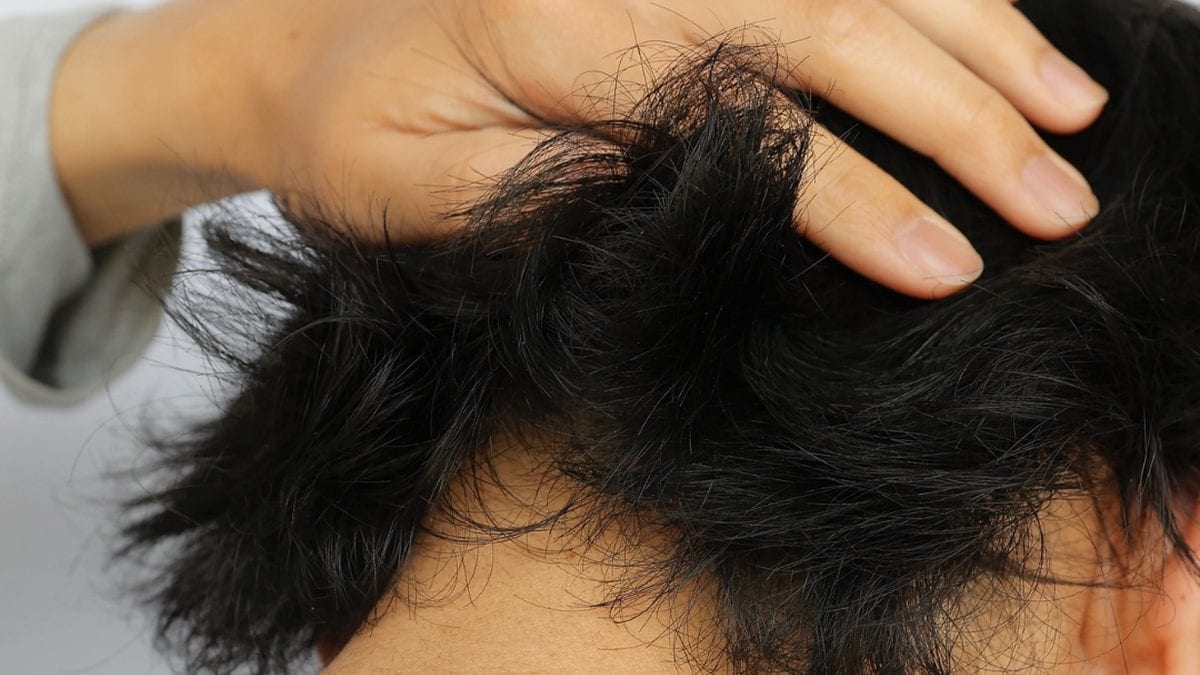
What is retrograde alopecia, and how does it affect the donor area?
In retrograde alopecia the hair thins from the nape hairline upwards and around the ears, and the lower edge of the safe donor area shrinks.
Retrograde alopecia starts low at the nape and around the ears and works its way upwards. It's easily overlooked, and it makes the donor reserve smaller than the plan may assume.
What is retrograde alopecia?
It's hair loss that moves in the opposite direction to the usual pattern, from the hairline at the back upwards, and around the ears. It varies a lot: some get none at all, while others lose a fair amount of usable donor hair even though the middle of the back of the head is still dense.
When people talk about androgenetic alopecia, most think of a hairline moving back and a crown getting bigger. Retrograde alopecia is the less familiar movement in the other direction. Thinning starts at the nape hairline and around the ears and climbs upwards, into the bottom and sides of what's normally seen as a safe donor area.
The differences between people are large. Many men show no sign of it. Others develop slow thinning low at the back and around the ears that noticeably reduces how much donor hair can be used, sometimes while the middle of the back of the head still looks completely dense.
Why does retrograde alopecia matter so much when extraction is planned?
Because it affects exactly the edges an over-ambitious plan stretches into when the middle doesn't yield enough grafts. The reserve is then smaller than the central density suggests, and grafts from the edge may disappear again while the area they came from becomes even thinner.
The zones retrograde alopecia affects are the same zones extraction is often extended into when the middle of the donor area doesn't deliver the graft count that was promised.
The mistake feeds itself. If you have thinning from below, your real reserve is smaller than the density in the middle of the back of the head suggests. If the plan was based on the middle, and extraction is then stretched out into the edge that's already affected, you've been given grafts that may not last, and at the same time thinned an area that was on its way to becoming thin anyway.
It can end with a nape line that looks ragged, thinning above the ears and grafts that gradually fade over the next ten years.
How does the surgeon detect retrograde alopecia?
By examining the edges of the donor area under magnification, from the nape hairline to the skin around the ears. The surgeon looks for miniaturised hairs, hairs of different thickness side by side, a nape hairline that has become indistinct and lower density above the ears than in the middle at the back.
The surgeon has to examine the edges of the donor area under magnification, from the nape hairline and the lowest part of the neck to the skin around the ears. It isn't enough to measure in the dense middle, where density is usually recorded.
- Miniaturisation: full-thickness hairs mixed with clearly thinner hairs in the same field.
- Variation in hair diameter: neighbouring hairs of different thickness. This is the classic trichoscopic sign of androgen-driven thinning.
- An indistinct nape hairline: the transition from normal hair to vellus hair has moved upwards and become more diffuse than before.
- Lower density above the ears than in the middle of the back of the head.
A single measurement in the middle of the donor area picks up none of this. That's why density should be measured in several places.
What does retrograde alopecia mean for the question of whether the donor area is safe?
It belongs on the same scale as the question Maas and colleagues and Xu and colleagues have raised, about whether the back of the scalp is really spared from hair loss. At the far end of the scale is DUPA, diffuse unpatterned alopecia, where surgeons usually advise against a transplant. Thinning from below is a milder and far more common variant.
Retrograde alopecia is one point on a sliding scale, and that scale is about whether the donor area really is spared. The question has been put bluntly in recent publications. Maas and colleagues challenge the habit of using the back of the scalp as an untouched control when hair loss is far advanced. Xu and colleagues examined the crown and the back of the scalp in pairs and argue that a spared back of the scalp is assumed more often than it's checked.
At the far end you'll find DUPA, diffuse unpatterned alopecia. There the whole scalp is affected, including the donor area, and a transplant is usually not advisable. Thinning from below at the edges is far milder and far more common, but it's the same kind of warning: the donor area isn't safe just because it's at the back.
What should you do if you're worried about retrograde alopecia?
Ask whether the edges, meaning the nape and the skin around the ears, were examined under magnification, and what the surgeon found. With thinning from below, expect tighter limits and fewer grafts, and photograph your nape and sides before the procedure.
- Get confirmation that the edges of the donor area were checked under magnification, including the nape and the skin around the ears, and ask to hear the findings.
- If there's thinning from below, the extraction limits should be tightened and the graft count should come down. That's the right response, not a bad sign about the clinic.
- Ask for a concrete reason if anyone suggests taking grafts from the nape or just above the ears.
- Discuss medical treatment with a doctor. The thinning is driven by androgens, and it's precisely your own hair that medication can affect.
- Photograph your nape line and sides before the procedure, with the same hair length and the same lighting, so you have something to compare with later.
Sources
- Xu Y, et al. Case Report: Paired vertex-occipital assessment reveals donor-area involvement in diffuse unpatterned alopecia. Frontiers in Medicine, 2026;13:1797275. pubmed.ncbi.nlm.nih.gov/41982548
- Maas D, et al. Rethinking the occipital scalp as a control in advanced androgenetic alopecia. Journal of the American Academy of Dermatology, 2026 (ahead of print). pubmed.ncbi.nlm.nih.gov/42398778
- Jimenez F, Ruifernández JM. Distribution of human hair in follicular units. A mathematical model for estimating the donor size in follicular unit transplantation. Dermatologic Surgery, 1999;25(4):294-298. pubmed.ncbi.nlm.nih.gov/10417585
- Gupta AK, Venkataraman M, Talukder M, Bamimore MA. Finasteride for hair loss: a review. Journal of Dermatological Treatment, 2022;33(4):1938-1946. pubmed.ncbi.nlm.nih.gov/34291720
This text is based on published research and common clinical practice. It is meant as general information, is not medical advice and never takes precedence over what your own surgical team asks of you. If they tell you something different from what you read here, their advice is what counts.
Read more in the knowledge guide
Wondering what's possible for your hair?
Send three sharp photos of your hair, from the front, the top and the back. You'll get an honest answer on what can be done, roughly how many grafts it would take and what it costs.
- Free and with no obligation
- Photos are assessed by the clinic's medical team
- Replies usually within an hour in the daytime


A study tells you something about groups. Only a doctor who has seen your photos can say what applies to your hair. The medical team at the clinic at the top of our ranking offers a free assessment.
Goes to the clinic at the top of our ranking.