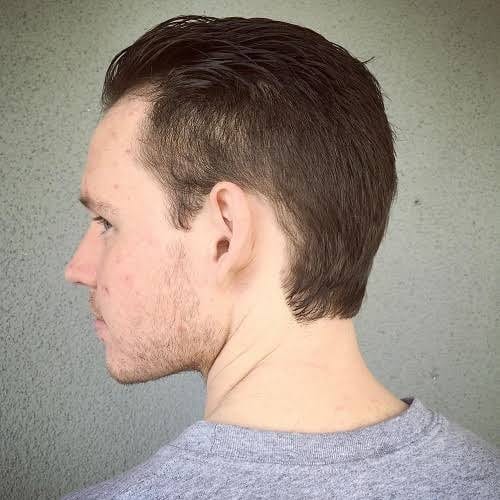
Temple hair as a donor: useful for detail, risky in volume
Temple hair is finer than the hair at the back of the neck, and in many men it recedes as hair loss progresses.
Above and in front of the ears, hair is finer than at the back of the neck, and in many men it recedes as hair loss progresses. It has one narrow, sensible use: fine detail in the hairline and temples. If it's harvested in larger amounts, that's a warning sign.
Where does the temple area start and end as a donor zone?
The temple area means the hair above and in front of the ears, up towards the temple points. Lowest down and furthest back, the zone blends into the safe part of the donor area. Compared with hair at the back of the neck, temple hair is usually finer, often doesn't grow as long, and grows at a characteristically flat angle along the scalp.
Why is temple hair a poor main donor source?
Four reasons. In many men, temple hair eventually disappears for androgenetic reasons. The hairs are finer, so each graft gives less coverage than a graft from the back of the neck. The area is very visible, so thinning gets noticed. And the flat angle makes extraction technically difficult and raises the risk of transection. Thinning from below can also reach this area, so stability is least certain right here.
- Many people lose it. Receding temples are part of the androgenetic picture, and in some patterns the temple points are among the first things to go. You can't count on hair taken from an area that's on its way out to stay.
- Finer hair. Less thickness means less coverage per graft. A hundred grafts from here fill less than a hundred from the back of the neck.
- Highly visible. People see the sides of your head all the time, including straight on. Thinner hair or small scars here show much more clearly than in the middle of the back of the neck.
- Hard to extract. Because the hair lies flat, it's harder to line the punch up with the follicle, and the risk of transection rises.
Thinning from below, which starts low at the nape and spreads around the ears, can also reach this zone. Of all the parts of the donor area, this is where you have the least certainty that the hair will stay.
What is temple hair actually good for?
Three narrow jobs, all because the hair is fine. The very front of the hairline, where fine hairs in an irregular row avoid the operated look that coarse nape hair gives. Rebuilding temple points, where new hairs have to match the fine hairs already there. And eyebrows. In each case we're talking about tens of grafts, not hundreds.
The quality that makes temple hair weak for volume is exactly what precision work needs.
- The very front edge of the hairline. A hairline that looks natural is made of single, fine hairs in an irregular row. Coarse nape hair placed right at the front is a classic reason a result looks operated on.
- Temple points. If they're to be rebuilt, the hair has to match the fine hair around them, and nape hair is too coarse for the job.
- Eyebrows, where fine hair is essential.
The number is small each time, a few tens of grafts rather than hundreds, and they're chosen because their qualities fit the job. Harvesting the temples to push up the total is something else entirely.
When should extraction from the temples raise suspicion?
When a lot is taken from here, the plan has usually grown bigger than the donor reserve. If the back of the neck can't deliver the number you were promised, the surgeon may reach up towards the crown, down into the nape or out towards the temples and take hair that may well disappear later. At the temples the damage is easiest to see: it shows in every profile photo.
What should I check about temple hair before and after surgery?
Ask to have the harvesting boundaries explained before surgery, and ask whether the temples are included. If the clinic suggests temple hair for the hairline, ask how many grafts that means: a few for fine-tuning is perfectly fine, many is not. Also ask whether the temples were examined under magnification for miniaturisation. Photograph the area before surgery, and check it for small extraction scars once it has healed.
- Get the boundaries of the extraction described before the day of surgery, and note whether the temple area is inside them.
- If temple hair is suggested for your hairline, ask how many grafts are involved. A small number for fine-tuning is fine. A large number is a bad sign.
- Ask whether your temples were checked for miniaturisation under magnification.
- Photograph the sides of your head, especially around and above the ears, before you get on the table.
- Look for small extraction scars in front of the ears and above the temples once it has healed.
Can temple points that are already receding be rebuilt?
Yes, and it can give good results. It takes fine hair, precise control of the angle and a cautious plan, because points that are too dense or placed too low look artificial. If the underlying process continues, the area will keep receding, and that is slowed with medical treatment agreed with a doctor, not with more grafts.
Receding temples are often the very reason people book a consultation. They change the frame of the face more than hair loss on top does.
Rebuilding the temple points is an established and sensible treatment. It's demanding: the hair has to be fine, the angle has to be right down to the degree, and the shape has to be restrained. Points that are too dense or set too low draw the eye. Remember too that the area will keep receding if the hair loss hasn't been stopped. That's a matter for medical treatment with a doctor, and more grafts won't solve it.
Sources
- Maas D, et al. Rethinking the occipital scalp as a control in advanced androgenetic alopecia. Journal of the American Academy of Dermatology, 2026 (ahead of print). pubmed.ncbi.nlm.nih.gov/42398778
- Xu Y, et al. Case Report: Paired vertex-occipital assessment reveals donor-area involvement in diffuse unpatterned alopecia. Frontiers in Medicine, 2026;13:1797275. pubmed.ncbi.nlm.nih.gov/41982548
- Jimenez F, Ruifernández JM. Distribution of human hair in follicular units. A mathematical model for estimating the donor size in follicular unit transplantation. Dermatologic Surgery, 1999;25(4):294-298. pubmed.ncbi.nlm.nih.gov/10417585
- Romera de Blas C, Vega Díez D, Ricart Vayá JM, Gómez Zubiaur A. Complications in follicular unit excision hair transplantation: current evidence and practical approaches. Frontiers in Medicine, 2026;13:1750989. pubmed.ncbi.nlm.nih.gov/41709896
- Rassman WR, Bernstein RM, McClellan R, Jones R, Worton E, Uyttendaele H. Follicular unit extraction: minimally invasive surgery for hair transplantation. Dermatologic Surgery, 2002;28(8):720-728. pubmed.ncbi.nlm.nih.gov/12174065
This article is based on published studies and on how specialists usually work. It is meant as general information, not as medical advice for you, and it never takes precedence over what your surgical team has asked you to do. If they say something different from what is written here, their advice is the one to follow.
Wondering what's possible for your hair?
Send three sharp photos of your hair, from the front, the top and the back. You'll get an honest answer on what can be done, roughly how many grafts it would take and what it costs.
- Free and with no obligation
- Photos are assessed by the clinic's medical team
- Replies usually within an hour in the daytime


A study tells you something about groups. Only a doctor who has seen your photos can say what applies to your hair. The medical team at the clinic at the top of our ranking offers a free assessment.
Goes to the clinic at the top of our ranking.