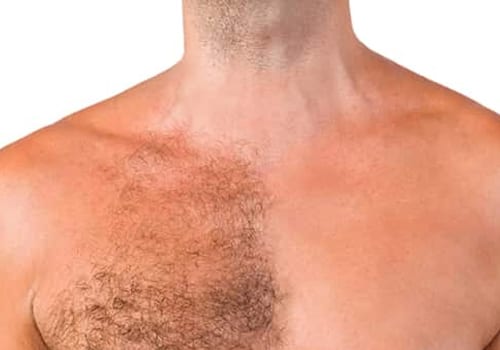
Chest and body hair as donor: a last resort with limits
When donor hair from the back of the head and the beard isn't enough, body hair can add a little extra. A multicentre study shows it can be done with FUE.
If the donor hair on your scalp and beard is used up, body hair can give you a little more to work with, and a multicentre study has shown it can be harvested with FUE. How many grafts take, and how they grow, is still less predictable than when the grafts come from the scalp or beard. Body hair is therefore the last thing you turn to.
When is body hair used in a hair transplant?
Only when donor hair from the scalp and beard can't provide what the plan needs. That applies with very extensive hair loss, with repairs where earlier procedures have depleted the scalp, and in people who naturally have sparse donor hair. Chest hair is used most often, because there is usually plenty of it and the scars are easy to hide.
What does research tell us about body hair transplants?
The key paper came in 2024, when Umar and colleagues published a multicentre study in Dermatologic Surgery. It described FUE of beard and body hair using a skin-responsive device. It documents that body hair can be used as an additional source. It does not show that body hair is as good as scalp hair, and no serious professional claims it is.
What makes body hair different when it's moved to the scalp?
The explanation lies in biology. The follicle brings its short growth phase with it, so the hair doesn't grow as long as scalp hair. A larger share of the hairs are resting at any one time. The hair is often curly, and almost every unit has only one hair. How many grafts survive the move is also harder to predict.
It is biology, not technique, that makes body hair different, and biology sets the limits on what it can be used for.
- Short growth phase. Body hair spends less time growing than scalp hair. That is why chest hair never gets as long as the hair on your head. This trait largely stays with the follicle when it is moved, so transplanted body hair usually stops growing at a shorter length.
- More resting hairs. At any given time, a larger share of body hairs are in the resting phase. That affects how much can be harvested on the day of surgery, and how the hair behaves after the move.
- Texture. Body hair often curls and has a different thickness from scalp hair.
- Almost only single hairs. Each graft therefore yields fewer hairs than a graft from the scalp.
- Uncertain yield. How many grafts take generally varies more than with scalp grafts, and the differences between people are large.
Why is body hair harder to extract than scalp hair?
Body follicles sit shallower, lie at a sharper angle and are often curved, and the skin reacts differently when the punch goes in. That means more transected follicles and fewer grafts per hour. So ask how many patients the surgeon has taken body hair from, and ask for photos taken a year later.
Where on the scalp does body hair go, and where is it kept away from?
Body hair is only placed where volume is needed and detail matters little, meaning the crown and mid-scalp, mixed with scalp hair. It has no place in the hairline, because its length is unpredictable, its texture is different and each graft has only one hair. Body hair fills in behind the hairline. The plan can't rest on it.
The same principle as for beard hair applies here, only even more strictly. Body hair is placed where volume matters and detail doesn't: in the crown and mid-scalp, usually beneath or between scalp grafts.
It isn't used in the hairline. Unpredictable length, a different texture and only one hair per graft make it unusable in the area everyone judges the result by.
Realistically, body hair adds a little extra density behind the visible front section when coverage would otherwise be too poor. It can build on a plan, but never be its foundation.
What should you clarify before agreeing to use body hair?
Ask why you need body hair, and why the reserve on your scalp and beard is used up. Ask how much experience the surgeon has with these procedures, and ask for photos a year later. Find out how many grafts they expect to take, and what the plan is if fewer do. Ask where the grafts will go, and how your chest will look afterwards.
- Why do I need body hair, and what has used up the donor hair on my scalp and beard?
- How many patients have you taken body hair from, and can I see how it turned out after twelve months?
- How many of the grafts do you expect to take, and what do we do if fewer do?
- Where will the grafts be placed, and how will the difference in texture look?
- How will the skin on my chest look where the grafts were taken?
If the clinic suggests body hair while there is still donor hair left on your scalp, the first thing to ask is why the plan has become so large.
It is still the donor area on the scalp that decides what is possible. Read more about the donor reserve.
Sources
- Umar S, Khanna R, Maldonado JC, Chouhan K, Gonzales A. Beard and Body Hair Transplantation by Follicular Unit Excision Using a Skin-Responsive Device: A Multicenter Study. Dermatologic Surgery, 2024;50(3):306-308. pubmed.ncbi.nlm.nih.gov/38127669
- Zhu DC, He Y, Fan ZX, Wang J, Qu Q, Hu ZQ, Miao Y. Large-Scale Beard Extraction Enhances the Cosmetic Results of Scalp Hair Restoration in Advanced Androgenetic Alopecia in East Asian Men: A Retrospective Study. Dermatology and Therapy, 2020;10(1):151-161. pubmed.ncbi.nlm.nih.gov/31784942
- Zhao Y, Zhang J, Jiang B, Fan Z, Miao Y. Development of an Evaluation System to Classify Beard Donor Area for Hair Transplantation. Dermatologic Surgery, 2025;51(9):882-886. pubmed.ncbi.nlm.nih.gov/40323042
- Romera de Blas C, Vega Díez D, Ricart Vayá JM, Gómez Zubiaur A. Complications in follicular unit excision hair transplantation: current evidence and practical approaches. Frontiers in Medicine, 2026;13:1750989. pubmed.ncbi.nlm.nih.gov/41709896
This article summarises published research and common clinical practice. It is meant as general information and is not medical advice. Nor does it replace the advice you get from your own surgical team. If your team tells you something different from what is written here, follow your team.
Wondering what's possible for your hair?
Send three sharp photos of your hair, from the front, the top and the back. You'll get an honest answer on what can be done, roughly how many grafts it would take and what it costs.
- Free and with no obligation
- Photos are assessed by the clinic's medical team
- Replies usually within an hour in the daytime


A study tells you something about groups. Only a doctor who has seen your photos can say what applies to your hair. The medical team at the clinic at the top of our ranking offers a free assessment.
Goes to the clinic at the top of our ranking.