Beard or scalp as donor: how does healing differ?
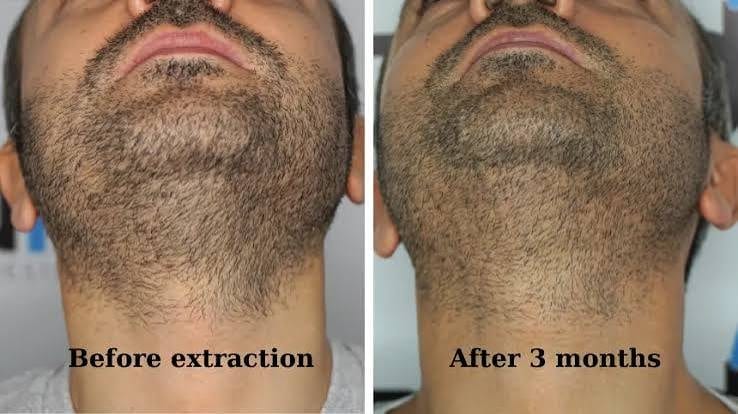
Small extractions in the beard usually close quickly and disappear under the beard as it grows back. The downside is that your face is on show to everyone while it heals, and beard hair keeps its own character in its new place.
Extractions from the beard usually heal quickly, and the beard that grows back covers the area well. The price is that your face is visible to the world during the healing weeks, and beard hair doesn't turn into scalp hair when it is moved. In other words, you trade fast healing and good coverage for visibility and a hair with a different texture.
Why do surgeons take hair from the beard?
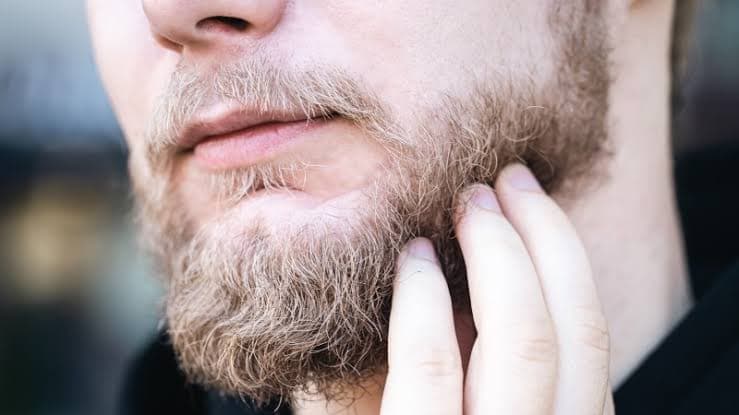
The beard is the most common backup source when the scalp doesn't have enough hair to give, because it is often dense with thick hairs. That thickness gives good fullness in the mid-scalp and crown. The hairline is a poor place for beard hair, because it needs fine hairs, not coarse ones.
The beard is used in addition to donor hair from the back of the head, not instead of it. The surgeon uses it to stretch the supply when the numbers wouldn't otherwise add up.
How do beard extraction sites heal?
Facial skin usually heals quickly, and the small punch holes close within a short time. The redness that follows can last from a few days to a couple of weeks and is easier to see than on the scalp, precisely because it is on the face. The dot marks usually fade, the regrowing beard covers the area, and inflamed follicles or ingrown hairs can appear, just as after shaving.
- The small punch holes in the facial skin usually close quickly
- Redness for a few days and up to a couple of weeks, more visible than at the back of the head because it is on the face
- The small dots usually fade over time
- Regrowth in the beard covers the area well
- Inflamed hair follicles (folliculitis) and ingrown hairs, familiar to many from shaving
What is the difference between beard hair and scalp hair as donor?
The biggest difference is visibility: the back of the head can be hidden under hair, but the face is exposed, and you usually can't shave the area while it heals. The hair itself is thicker, often wiry and straight, the colour may differ, and it keeps the properties of beard hair after the move rather than becoming like the hair around it.
- Who sees it. Extractions at the back of the head can be covered by the hair above. The face has no such cover.
- The razor. The area should usually be left alone while it heals.
- The hair itself. Thicker, often wiry and straight, sometimes a different shade from the scalp.
- How it grows afterwards. Moved beard hair keeps growing like beard hair and doesn't become like the hair around it.
- How much the beard can spare. If the surgeon takes too much, you get visible sparse patches in the beard, which is a cosmetic problem in itself.
What should you clarify with the surgeon before your beard is used as donor?
Ask how many grafts the surgeon plans to take from the beard and what that will do to your appearance, where they will be placed and why exactly there, and how coarse beard hairs will be blended with the finer hairs from the scalp. Also ask what happens if you later want a fuller beard.
- How many grafts will you take from the beard, and what will the beard look like afterwards?
- Where will these grafts be placed, and why that area?
- How will you blend coarse beard hairs with finer hair from the scalp?
- If I want a fuller beard in a few years, what will I have left to work with?
What ultimately decides how many grafts you have available is explained in the guide to donor supply.
Sources and caveats
- True RH. Using Nonscalp Hair in Scalp Hair Restoration-Theory and Execution. Indian Journal of Plastic Surgery, 2021;54(4):463-470. pubmed.ncbi.nlm.nih.gov/34984086
- Zhu DC, He Y, Fan ZX, Wang J, Qu Q, Hu ZQ, Miao Y. Large-Scale Beard Extraction Enhances the Cosmetic Results of Scalp Hair Restoration in Advanced Androgenetic Alopecia in East Asian Men: A Retrospective Study. Dermatology and Therapy, 2020;10(1):151-161. pubmed.ncbi.nlm.nih.gov/31784942
- Gupta B, Banerjee P, Priyadarshini Y, Rathi P. BEARD - A Potential Donor Site in Grade 6 and Grade 7 Alopecia: A Case Series. Journal of Maxillofacial and Oral Surgery, 2021;20(4):545-550. pubmed.ncbi.nlm.nih.gov/34776682
- Umar S. Body Hair Transplant by Follicular Unit Extraction: My Experience With 122 Patients. Aesthetic Surgery Journal, 2016;36(10):1101-1110. pubmed.ncbi.nlm.nih.gov/27241361
This article is based on published research and common clinical practice. It is general information, not medical advice. The instructions from your own surgical team always come first: if they tell you something different from what you read here, follow them.
Wondering what's possible for your hair?
Send three sharp photos of your hair, from the front, the top and the back. You'll get an honest answer on what can be done, roughly how many grafts it would take and what it costs.
- Free and with no obligation
- Photos are assessed by the clinic's medical team
- Replies usually within an hour in the daytime


A study tells you something about groups. Only a doctor who has seen your photos can say what applies to your hair. The medical team at the clinic at the top of our ranking offers a free assessment.
Goes to the clinic at the top of our ranking.