Can scalp micropigmentation hide hair transplant scars?
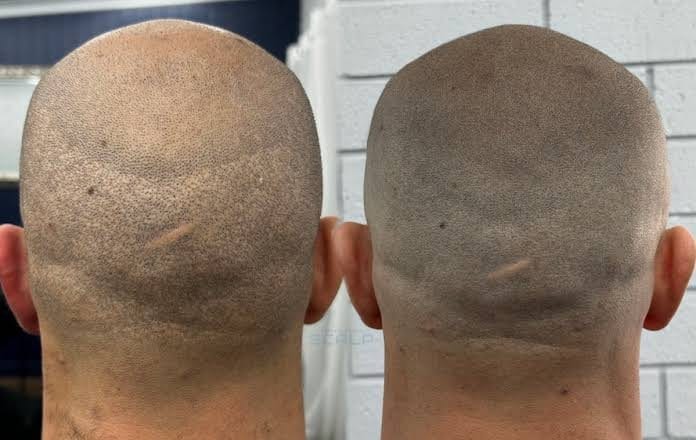
Tiny pigment dots that look like freshly cut stubble can make a donor scar far less noticeable. It won't give you new hair, and the scar has to settle before anyone starts.
In micropigmentation, tiny dots are tattooed into the scalp so they look like short hairs. A pale donor scar then stands out less, because the contrast with the surrounding hair shrinks. The treatment belongs after healing, usually not until many months after surgery.
What does micropigmentation do to a hair transplant scar?
It camouflages the scar without changing the tissue itself: tiny pigment dots are tattooed into the skin and resemble closely cropped hairs, while no follicles grow or are moved. A pale, hairless strip scar shows because it contrasts with the darker hair around it, and the pigment blurs exactly that contrast.
Think of it as shadow, not hair. The eye looks for breaks in the pattern, and a pale patch in the middle of dark stubble is an obvious break. If you fill the patch with dots in the same tone as the hair, the break largely disappears, even though the scar is still there under the pigment.
Where is micropigmentation most useful?
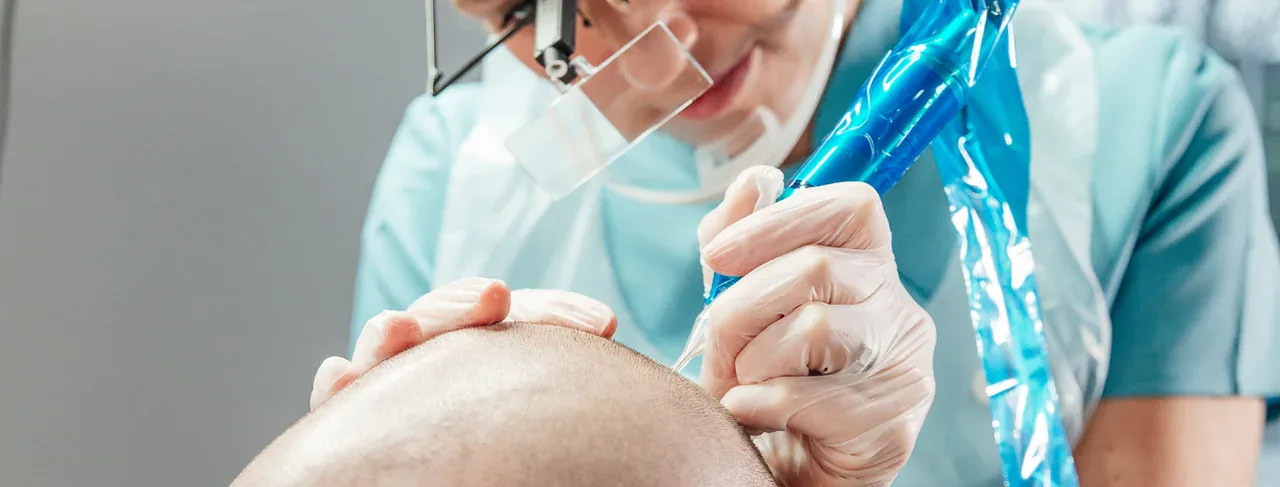
The classic case is the linear scar after strip surgery, and almost as common is an FUE donor area that has become sparse from many scattered extractions. The technique is also used alongside surgical repair of older, poorly performed work, and as a general way to make the scalp show through less where the hair is thin.
- Strip scars after FUT, where the method was first used
- A sparse donor area after FUE, where many small extraction points have added up to a thinner area
- Older work with a poor result, as a complement to surgical repair
- The impression of more density, where dots between your existing hairs make the scalp less visible
How long should you wait after surgery before micropigmentation?
Wait until the scar has fully matured, usually many months. Scar tissue keeps changing colour, thickness and surface long after the procedure, and pigment placed while this is happening can migrate or take unevenly. Practitioners often recommend allowing plenty of time and working with the surgeon, so that any surgery is done first and the pigmentation comes last.
The order matters. If you are going to have more grafts or a scar revision, do that before the pigment goes in, or you risk putting colour into skin that will later be cut or moved.
What are the limitations of micropigmentation?
The result looks like stubble, so it suits you best if you keep your hair short. The pigment fades over the years and needs topping up, and the outcome stands or falls on the practitioner's skill. Grey or greying hair is hard to match, and a raised scar with an uneven surface becomes less visible in colour but stays just as uneven to the touch.
- The effect is stubble, so it works best when the hair is kept short
- The colour fades over the years and needs touching up
- Quality varies greatly from practitioner to practitioner, because this is a craft
- Grey or greying hair makes colour matching difficult
- A raised, textured scar gets less contrast, but the surface stays the same
The technique itself, and what a treatment involves, is covered on the page about scalp micropigmentation.
Sources and caveats
- Rassman WR, Pak JP, Kim J, Estrin NF. Scalp micropigmentation: a concealer for hair and scalp deformities. The Journal of Clinical and Aesthetic Dermatology, 2015;8(3):35-42. pubmed.ncbi.nlm.nih.gov/25852813
- Romera de Blas C, Vega Díez D, Ricart Vayá JM, Gómez Zubiaur A. Complications in follicular unit excision hair transplantation: current evidence and practical approaches. Frontiers in Medicine, 2026;13:1750989. pubmed.ncbi.nlm.nih.gov/41709896
This article is based on published research and common clinical practice. It is general information, not medical advice. The instructions from your own surgical team always come first: if they tell you something different from what you read here, follow them.
Wondering what's possible for your hair?
Send three sharp photos of your hair, from the front, the top and the back. You'll get an honest answer on what can be done, roughly how many grafts it would take and what it costs.
- Free and with no obligation
- Photos are assessed by the clinic's medical team
- Replies usually within an hour in the daytime


A study tells you something about groups. Only a doctor who has seen your photos can say what applies to your hair. The medical team at the clinic at the top of our ranking offers a free assessment.
Goes to the clinic at the top of our ranking.