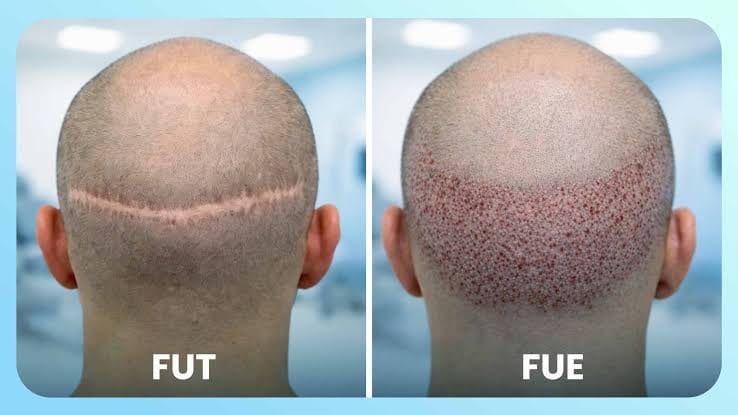
Tight scalp after FUE or FUT: how long does it last?
After FUE, slight tightness usually passes within about a week. After FUT (strip method), clear tightness lasts one to three weeks, because the incision is stitched closed. How tight your scalp feels depends almost entirely on the method.
The method decides almost everything. In FUT (strip method), a piece of scalp is removed and the opening stitched closed, which causes real tightness that lasts. In FUE, follicles are taken out one by one, and the slight tightness you feel comes from swelling and passes quickly, because nothing had to be pulled together.
Why do FUT and FUE feel so different?
In the strip method, a band of scalp is cut away and the edges are stitched together. The scalp has little give, so the join creates real tightness that you feel for weeks. FUE takes out follicular units one at a time, and there's no opening to close. The tightness you feel comes from swelling and lots of tiny wounds, and it goes once the swelling goes down.
In the strip method, the surgeon removes a band of scalp and stitches the edges together. The scalp stretches far less than skin elsewhere on the body, so closing it puts real tension on the tissue. You notice it for several weeks, which is why strip patients are told not to stretch the area.
In FUE, follicular units are taken out one at a time, and no opening needs to be pulled closed. What little tightness you feel comes from the swelling and all the tiny wounds, and it disappears along with the swelling.
What can you expect after FUT?
Clear tightness for one to three weeks, with a pulling feeling when you bend your neck or turn. It eases gradually as the tissue stretches and remodels. If the strip was wide compared with how much give the scalp has, the tightness can last longer, and that same tension is what can make a strip scar widen.
- Clear tightness for one to three weeks after the procedure
- A pulling feeling when you bend your neck or twist
- It eases slowly as the tissue stretches and remodels
- Sometimes it lingers, if the strip was wide relative to the scalp's give
Too much tension when the edges are stitched together is also the main reason strip scars widen. That's why the surgeon checks how mobile your scalp is before deciding how wide the strip should be.
What can you expect after FUE?
Only slight tightness for a few days, mostly linked to swelling rather than any stitching. It is usually gone after about a week, and you don't get the lasting pulling feeling you get after the strip method.
- Slight tightness for a few days, mostly due to swelling
- Usually gone after about a week
- No pulling feeling that lingers
When is tightness a warning sign?
When it gets worse rather than better after the first few days, when it comes with severe pain, marked swelling or a hard lump, which can be bleeding under the skin, or when the skin over the stitches is pale, bluish or shiny. Get in touch if you also have a fever.
- The tightness increases after the first few days, when it should be easing
- It comes with severe pain, marked swelling or a hard lump, which can mean bleeding under the skin
- The skin over the stitches is pale, bluish or shiny
- Fever together with any of the points above
Sources
- Kerure AS, Patwardhan N. Complications in Hair Transplantation. Journal of Cutaneous and Aesthetic Surgery, 2018;11(4):182-189. pubmed.ncbi.nlm.nih.gov/30886471
- Rassman WR, Bernstein RM, McClellan R, Jones R, Worton E, Uyttendaele H. Follicular unit extraction: minimally invasive surgery for hair transplantation. Dermatologic Surgery, 2002;28(8):720-728. pubmed.ncbi.nlm.nih.gov/12174065
- Romera de Blas C, Vega Díez D, Ricart Vayá JM, Gómez Zubiaur A. Complications in follicular unit excision hair transplantation: current evidence and practical approaches. Frontiers in Medicine, 2026;13:1750989. pubmed.ncbi.nlm.nih.gov/41709896
This article brings together findings from published research and standard clinical practice. It is general information, not medical advice. The instructions from the team that operated on you come first. If they say something different from what you read here, follow their advice.
Wondering what's possible for your hair?
Send three sharp photos of your hair, from the front, the top and the back. You'll get an honest answer on what can be done, roughly how many grafts it would take and what it costs.
- Free and with no obligation
- Photos are assessed by the clinic's medical team
- Replies usually within an hour in the daytime


A study tells you something about groups. Only a doctor who has seen your photos can say what applies to your hair. The medical team at the clinic at the top of our ranking offers a free assessment.
Goes to the clinic at the top of our ranking.