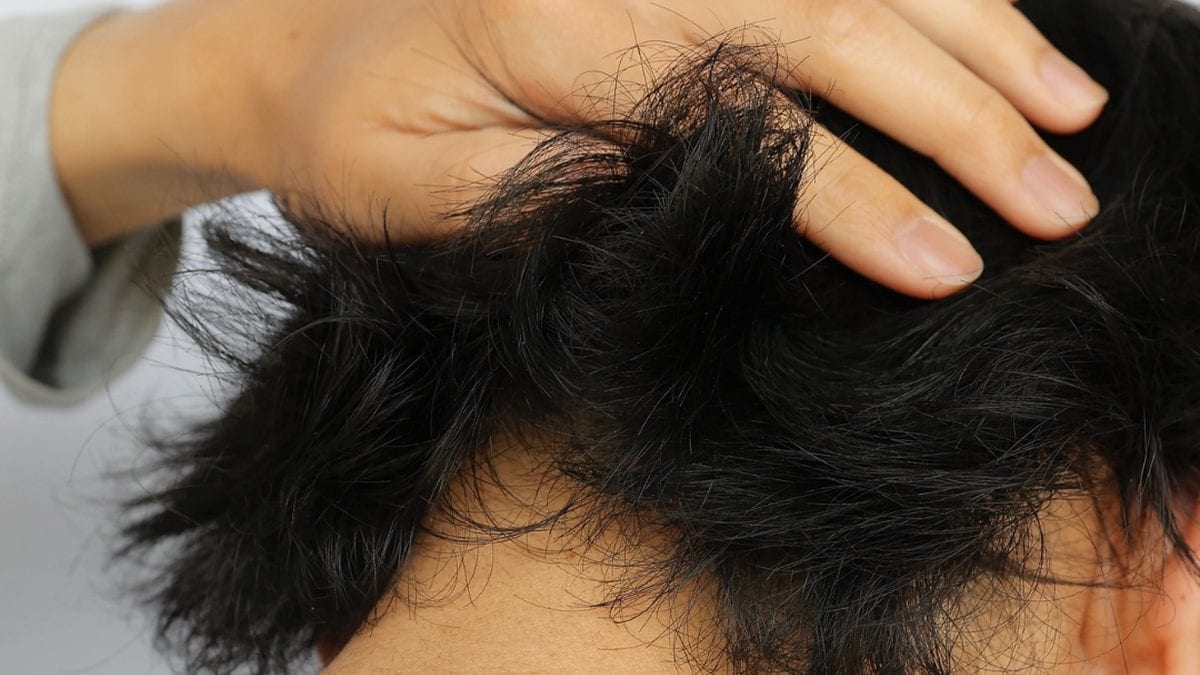
Can donor hair miniaturise? Signs the back of the head is thinning
Yes. Donor hair can miniaturise, which means its follicles produce ever finer hairs. It is the defining sign of androgen-driven hair loss.
When the follicles in the donor area produce ever finer hairs, it is a sign of androgen-driven thinning. Found before surgery, it means the plan has to change. Found afterwards, it often explains why the result faded.
What does miniaturisation mean in hair loss?
Miniaturisation is the process in which DHT-sensitive follicles produce a slightly finer, shorter and lighter hair with each growth cycle, until only a barely visible vellus hair is left. It happens gradually, and for a long time the area can look dense to the naked eye.
Androgenetic alopecia doesn't switch hair follicles off. It makes them smaller. Under the influence of DHT, sensitive follicles produce a hair with each new growth cycle that is a little finer, a little shorter and a little lighter than the one before. In the end, all that is left where a strong hair once grew is a wispy vellus hair.
The process is slow, and at first you can't see it. An area can look completely normal while a good share of its follicles are already shrinking. A fine hair still takes up space, and it still reflects light.
By the time you notice your hair is thinner, the process has been going on for a long time. Under magnification it can be seen much earlier.
Why does donor area miniaturisation undermine the basis for a transplant?
The procedure assumes that donor follicles resist DHT and keep producing strong hairs in their new place. A follicle that is already shrinking does not, and it doesn't stop shrinking because it is moved, so after a good twelve-month result the hair can gradually fade.
A transplant rests on one assumption: the follicles from the donor area resist DHT and will keep producing full hairs once they have been moved. A follicle that is already shrinking before surgery does not resist DHT. Moving it doesn't change that. The follicle carries on with the process in its new position.
What you get looks good at twelve months and then slowly thins. Donor reserve has been spent on grafts that could never last, and the back of your head has dot scars with nothing lasting to show for them.
So the donor examination isn't a form to be filled in. It tests whether the core assumption behind the procedure holds true for you in particular.
What does trichoscopy look for in donor hair?
The surgeon looks for neighbouring hairs of clearly different thickness, more fine and vellus hairs, and follicular units that have lost hairs. The examination should be done in several places, including the edges, because thinning that creeps up from below reaches the edges first.
The tool is trichoscopy, an examination of the scalp under magnification. These are the findings that count:
- Variation in hair diameter. Mature hairs in the same small area that differ noticeably in thickness. In a stable donor area the thickness is fairly even. Where thinning has started, it varies.
- More fine and vellus hairs than is usual for the area.
- Units that have lost hairs. A cluster that once had three hairs now has two, and later one.
- Changes around the follicles, such as pigment or a brownish ring around the opening. These are linked to the inflammatory side of androgenetic alopecia.
The surgeon should examine several points, including the edges. Thinning that creeps up from below may already have started at the margins while the middle of the back of the head still looks healthy.
What happens to the plan if the surgeon finds miniaturisation?
The finding doesn't always rule out surgery, but the terms change. If it is mild and limited to the edges, the boundaries tighten and the number of grafts goes down. If it is moderate and more widespread, medication comes first, with a smaller plan for the front. If the whole donor area is affected and thinning is diffuse elsewhere too, it points to DUPA, where a transplant is rarely recommended.
The finding doesn't necessarily rule out surgery. It sets new conditions.
- Mild miniaturisation at the edges: extraction is pulled in towards the healthy centre, and the number of grafts is reduced accordingly.
- Moderate findings over a larger area: a strong argument for starting medication and for a smaller, more cautious plan that only addresses the front.
- Miniaturisation across the whole donor area, especially together with diffuse thinning elsewhere: the suspicion then turns to DUPA, diffuse thinning with no set pattern. Here a transplant is usually advised against. Xu and colleagues argue that the donor area is overlooked too often in this presentation, precisely because people assume the back of the head is spared instead of checking it.
Is the assumption of a stable donor area being questioned even without miniaturisation?
Yes, increasingly. In 2026 Maas and colleagues challenged the habit of using the hair at the back of the head as an untouched control when hereditary hair loss is far advanced. Donor hair should therefore be described as largely resistant, not permanent, and it should be examined, not taken for granted.
What should you ask about miniaturisation before surgery?
Ask whether your donor area was examined under magnification, in how many places and whether the edges were included. Ask for an answer on whether there was miniaturisation or varying hair diameter, whether DUPA has been ruled out, and how the findings have shaped the plan you've been given.
- Was my donor area examined under magnification? In how many places, and were the edges included?
- Did you see miniaturisation or hairs of varying thickness?
- Has diffuse unpatterned thinning (DUPA) been ruled out?
- Which parts of your plan are a result of what you found?
Sources
- Xu Y, et al. Case Report: Paired vertex-occipital assessment reveals donor-area involvement in diffuse unpatterned alopecia. Frontiers in Medicine, 2026;13:1797275. pubmed.ncbi.nlm.nih.gov/41982548
- Maas D, et al. Rethinking the occipital scalp as a control in advanced androgenetic alopecia. Journal of the American Academy of Dermatology, 2026 (ahead of print). pubmed.ncbi.nlm.nih.gov/42398778
- Jimenez F, Ruifernández JM. Distribution of human hair in follicular units. A mathematical model for estimating the donor size in follicular unit transplantation. Dermatologic Surgery, 1999;25(4):294-298. pubmed.ncbi.nlm.nih.gov/10417585
- Gupta AK, Venkataraman M, Talukder M, Bamimore MA. Finasteride for hair loss: a review. Journal of Dermatological Treatment, 2022;33(4):1938-1946. pubmed.ncbi.nlm.nih.gov/34291720
- Romera de Blas C, Vega Díez D, Ricart Vayá JM, Gómez Zubiaur A. Complications in follicular unit excision hair transplantation: current evidence and practical approaches. Frontiers in Medicine, 2026;13:1750989. pubmed.ncbi.nlm.nih.gov/41709896
This article is based on published research and standard clinical practice. It is general information, not medical advice, and it never takes priority over what your own surgical team tells you. If they say something different from what you read here, follow their advice.
Wondering what's possible for your hair?
Send three sharp photos of your hair, from the front, the top and the back. You'll get an honest answer on what can be done, roughly how many grafts it would take and what it costs.
- Free and with no obligation
- Photos are assessed by the clinic's medical team
- Replies usually within an hour in the daytime


A study tells you something about groups. Only a doctor who has seen your photos can say what applies to your hair. The medical team at the clinic at the top of our ranking offers a free assessment.
Goes to the clinic at the top of our ranking.