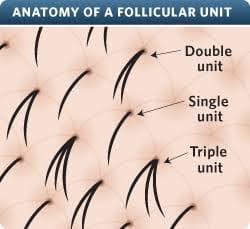
Follicular units: how many hairs are in each graft?
Your hair grows in small clusters of one to four hairs, and the mix varies from person to person.
A hair rarely grows on its own. It grows together with one, two or three others in a follicular unit, and the average number of hairs in your units decides how much hair an offer of a given number of grafts really contains. Grafts and hairs are therefore two different units of measurement.
What exactly is a follicular unit, and why does the mix matter?
A follicular unit is a natural cluster of one to four fully developed hairs that share sebaceous glands, a tiny arrector pili muscle and surrounding connective tissue. The surgeon moves whole clusters instead of single hairs or large plugs, and that's why the result can look natural.
If you look at the scalp through a magnifying glass, you'll see that hair isn't spread evenly, one hair at a time. It emerges in small groups, follicular units, with one to four mature hairs in each. The hairs in a group share sebaceous glands and a tiny arrector pili muscle, and they're wrapped in the same connective tissue.
The whole of modern hair transplantation is built on this anatomy. Older techniques moved larger plugs and gave a tufted look. Today each unit is moved intact, just as it grew, and the hair that comes through behaves like normal hair.
The distribution has been studied systematically. In 1999 Jimenez and Ruifernández published a model in Dermatologic Surgery describing how hair is distributed in follicular units. The aim was practical: to be able to calculate how large a donor area a transplant needs. The model was built because the composition affects every single plan.
How much difference does the mix make when the graft count is the same?
A big one. With 2,000 grafts, an average of 2.4 hairs per unit gives about 4,800 hairs, while an average of 1.7 gives about 3,400, which is roughly 1,400 fewer hairs from exactly the same number.
Take two men who are both quoted 2,000 grafts. The averages below are examples, but they're within the usual range.
In the first, the donor area is mostly pairs and triple clusters. The average is perhaps 2.4 hairs per graft, so the 2,000 grafts contain about 4,800 hairs.
In the second, single hairs and pairs dominate, with an average of perhaps 1.7. Here the same 2,000 grafts hold about 3,400 hairs.
The gap is around 1,400 hairs, and it shows in the coverage, especially in the middle of the scalp where fullness shapes the overall impression. Both were given an honest number. The number simply means different things for the two of them, because their donor areas are made up differently.
Where on the scalp do single, double and larger units go?
Single hairs go at the very front of the hairline, where a natural edge is soft and uneven. Pairs are placed just behind to build density, while clusters of three or four hairs belong in the middle of the scalp and on the crown.
The mix is also a tool in the design itself, because each size works best in its own place.
- One hair: at the very front of the hairline. A real hairline is soft and a little irregular, built from single hairs in an uneven row. Multi-hair grafts right at the front are a classic reason a result looks obviously transplanted.
- Two hairs: just behind the edge, where density should build gradually towards the back.
- Three and four hairs: in the middle of the scalp and on the crown. There, fullness is what counts, and nobody studies the hair up close.
A team that plans properly sorts grafts by size as they're dissected and places each group deliberately. Without sorting, grafts end up wherever they happen to land, and you notice it first in the hairline.
Why can't you compare graft quotes and hair quotes directly?
Because grafts and hairs are two different units. A number given in hairs comes out at almost double the same job given in grafts, and some clinics state grafts but charge per hair, so you need to know which unit each quote uses.
When two units are mixed up, an offer can seem bigger or cheaper than it is.
Some clinics count hairs instead of grafts, and the number then comes out at nearly double for exactly the same job. Others state grafts but price per hair. That needn't be dishonest. But if you set a quote in grafts against a quote in hairs from another clinic, you're comparing apples and oranges.
Ask these questions before you compare: Is the number grafts or hairs? How many hairs do my units contain on average? And is the price per graft or per individual hair?
What should you ask the clinic about your own mix of units?
Ask how many hairs your units contain on average, what share are single hairs, who sorts the grafts by size and how many single hairs are set aside for the hairline. A concrete answer to the last one shows that someone has actually designed your hairline.
- How many hairs do my follicular units contain on average?
- What share of my donor units are single hairs?
- Are the grafts sorted by size, and who does it?
- How many single-hair grafts are set aside for the hairline?
The last question is the most revealing. If you get a number, there's a plan. If you get a vague answer, your hairline will probably be made from whatever happens to be ready.
Sources
- Jimenez F, Ruifernández JM. Distribution of human hair in follicular units. A mathematical model for estimating the donor size in follicular unit transplantation. Dermatologic Surgery, 1999;25(4):294-298. pubmed.ncbi.nlm.nih.gov/10417585
- Rassman WR, Bernstein RM, McClellan R, Jones R, Worton E, Uyttendaele H. Follicular unit extraction: minimally invasive surgery for hair transplantation. Dermatologic Surgery, 2002;28(8):720-728. pubmed.ncbi.nlm.nih.gov/12174065
- Parsley WM, Perez-Meza D. Review of factors affecting the growth and survival of follicular graft. Journal of Cutaneous and Aesthetic Surgery, 2010;3(2). jcasonline.com
- Zhao Y, Zhang J, Jiang B, Fan Z, Miao Y. Development of an Evaluation System to Classify Beard Donor Area for Hair Transplantation. Dermatologic Surgery, 2025;51(9):882-886. pubmed.ncbi.nlm.nih.gov/40323042
This text is based on published research and common clinical practice. It is meant as general information, is not medical advice and never takes precedence over what your own surgical team asks of you. If they tell you something different from what you read here, their advice is what counts.
Read more in the knowledge guide
Wondering what's possible for your hair?
Send three sharp photos of your hair, from the front, the top and the back. You'll get an honest answer on what can be done, roughly how many grafts it would take and what it costs.
- Free and with no obligation
- Photos are assessed by the clinic's medical team
- Replies usually within an hour in the daytime


A study tells you something about groups. Only a doctor who has seen your photos can say what applies to your hair. The medical team at the clinic at the top of our ranking offers a free assessment.
Goes to the clinic at the top of our ranking.