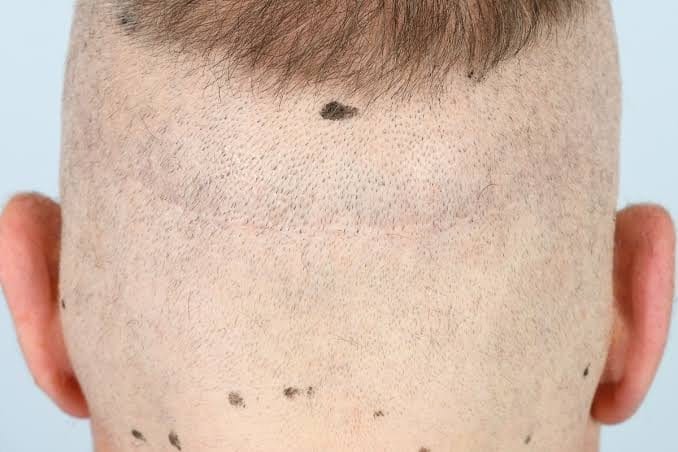
Limited donor hair: where are the limits of FUE?
If you have limited donor hair, surgery often can't give you what you're hoping for, and an honest surgeon will tell you so plainly.
With sparse donor hair, an honest surgeon often has to say that surgery can't deliver what you imagine. If you and the surgeon recognise this before the operation, you can end up with a modest but good result. If you don't, you risk a depleted donor area and a top that disappoints.
How many grafts do you have available over your lifetime?
The surgeon measures density in the safe zone, where around 65 to 85 follicular units per square centimetre is normal and around 40 or fewer is weak. The surgeon then multiplies by the area that can be used. Next, a share is set aside for future hair loss, because hereditary hair loss usually continues. What's left is what you have to distribute, and with low capacity the need often exceeds the reserve by a wide margin.
What happens if the surgeon takes too much?
Overharvesting doesn't give you a denser top. You get a thin top plus a visibly sparse back and sides, and the sparse back of the head is permanent and harder to cover than thin hair on top. The donor area doesn't grow back, so the damage can't be undone.
Which solutions are realistic when donor hair is limited?
You can lower your ambitions, for example by settling for a modest hairline and leaving the crown alone. You can start with medication to hold on to the hair you have, have micropigmentation as the only measure or combined with a small procedure so the contrast with the skin is reduced, or take grafts from the beard or body. Sometimes the right advice is not to operate.
- Lower ambitions. A conservative hairline that frames the face, and a crown that's left as it is.
- Medication first, so the hair you have is stable before donor hair is used.
- Scalp micropigmentation, on its own or combined with a smaller procedure, so the contrast with the skin is reduced.
- Beard or body hair as additional sources, with the limitations they have.
- No surgery, which is sometimes the best advice you can get.
How do you recognise a good consultation when donor hair is scarce?
The surgeon measures density, tells you how many grafts you have available, shows what that number can and can't achieve, and dares to say that your goal is out of reach. If a clinic responds to low donor density by proposing a large number of grafts anyway, that's a serious red flag.
A high graft count despite low donor density is at the top of our list of red flags.
Sources
- Parsley WM, Perez-Meza D. Review of factors affecting the growth and survival of follicular graft. Journal of Cutaneous and Aesthetic Surgery, 2010;3(2). jcasonline.com
- Jimenez F, Ruifernández JM. Distribution of human hair in follicular units. A mathematical model for estimating the donor size in follicular unit transplantation. Dermatologic Surgery, 1999;25(4):294-298. pubmed.ncbi.nlm.nih.gov/10417585
- Goldin J, Zito PM, Raggio BS. Hair Transplantation. StatPearls, 2025 (updated 2 Aug 2025). pubmed.ncbi.nlm.nih.gov/31613520
- Romera de Blas C, Vega Díez D, Ricart Vayá JM, Gómez Zubiaur A. Complications in follicular unit excision hair transplantation: current evidence and practical approaches. Frontiers in Medicine, 2026;13:1750989. pubmed.ncbi.nlm.nih.gov/41709896
This article is based on published research and established clinical practice in the field. It gives you general knowledge and is not medical advice. The instructions from the team operating on you take precedence, including where they differ from what is written here.
Wondering what's possible for your hair?
Send three sharp photos of your hair, from the front, the top and the back. You'll get an honest answer on what can be done, roughly how many grafts it would take and what it costs.
- Free and with no obligation
- Photos are assessed by the clinic's medical team
- Replies usually within an hour in the daytime


A study tells you something about groups. Only a doctor who has seen your photos can say what applies to your hair. The medical team at the clinic at the top of our ranking offers a free assessment.
Goes to the clinic at the top of our ranking.