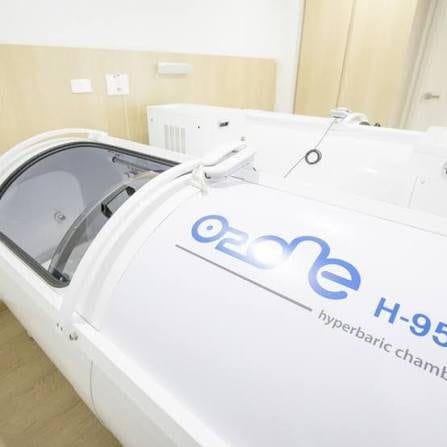
Diabetes and hair transplants: can HBOT help the grafts?
HBOT has its very best evidence in diabetic wounds that won't heal. That makes it easy to draw the same conclusion for people with diabetes who are having a transplant.
No use of HBOT is better documented than the treatment of diabetic wounds that won't heal. That makes it tempting to believe patients with diabetes will also benefit from HBOT with a hair transplant. But that is an inference, not a finding. No hair transplant study has recruited people with diabetes or looked at them as a separate group.
Why does diabetes matter for a hair transplant?

Diabetes can damage the smallest blood vessels and make wounds heal more slowly. In a transplant, that means the grafts have to draw nourishment from a recipient area with possibly weakened circulation, while thousands of small wounds in the donor area need to close. If your diabetes is well controlled, most surgeons will operate with a cautious density plan. If your blood sugar is poorly controlled, there is usually good reason to wait.
It is the small blood vessels and wound healing that make diabetes relevant. Over time, and especially when it is poorly controlled, the smallest blood vessels become damaged. Circulation weakens in exactly the tissue a transplant needs, and several steps in the body's wound repair slow down.
That raises two separate concerns. The grafts in the recipient area live off diffusion from tissue where the blood supply may not be what it should be. And the donor area has thousands of small extraction wounds that need to heal. If blood sugar is poorly controlled, this takes longer and infections become more common.
Well-controlled diabetes rarely rules out a transplant. The surgeon will then often plan a more modest density. If control is poor, it is usual to postpone until it improves. That decision is made by the surgical team together with your diabetes doctor.
When is HBOT well documented for wound healing?
For diabetic wounds that won't heal. Thom found that only two uses of HBOT are supported by both systematic reviews and randomised trials, and this is one of them. The other is radiation injury. Diabetic foot ulcers are on the list of approved hyperbaric indications and make up most of all hyperbaric treatment. The open question is whether any of this applies to a hair transplant.
Here, and only here, HBOT stands on solid ground. In his review, Thom places non-healing wounds in people with diabetes among the uses supported by systematic reviews and randomised clinical trials. He puts only two categories at that level. The other is damage after radiotherapy.
Problem wounds of selected types, including diabetic foot ulcers, are approved indications for hyperbaric treatment. In many health systems, this is what fills most of the capacity in the pressure chambers.
So if a clinic suggests HBOT because you have diabetes and are having a transplant, it is pointing to a real and well-documented use. The only question is whether what applies there can be carried over here.
Why can't you carry the findings on diabetic wounds over to hair transplants?
The studies on diabetic foot ulcers are about long-standing wounds that have stopped healing, in tissue with damaged small vessels and often with amputation as the looming alternative. There, HBOT rescues wounds that have already failed. A hair transplant in a person with well-controlled diabetes is a planned wound in a scalp with a rich blood supply, and it is expected to heal normally. People with diabetes have never been included as a separate group in any published HBOT study, so the transfer has never been tested.
The research on diabetic foot ulcers is about wounds that have been open for a long time, in tissue where small vessel disease is already established. Many of the patients also have disease in the large arteries of the legs, and amputation is often what awaits if nothing works. There, HBOT is a rescue attempt for a wound that has already failed.
That is a completely different situation from a hair transplant in someone with well-controlled diabetes. Here the wound is planned, it sits in a scalp with a good blood supply, and the patient has already been judged healthy enough for a cosmetic procedure. Normal healing is what is expected.
The scalp is also among the best-supplied areas of the body. That is why infections after a hair transplant are rare, and why the donor wounds often close quickly even in patients who otherwise heal slowly.
No published study of hyperbaric oxygen and hair transplants has deliberately included people with diabetes or reported figures for them as a separate group. The description of the 34 patients in Fan makes such an analysis impossible. Dong and Jin wrote a letter to the journal about exactly this: the original article gave too little account of differences between subgroups and of which medicines led to patients being excluded.
What matters if you have diabetes and are planning a hair transplant?
What shifts the surgical risk is how well your blood sugar is controlled in the period before you book, and your diabetes team can help here. If you tell the surgeon about your diabetes, they can plan a lower density or spread a large plan over two sessions, which puts less strain on the blood vessels. Also pay extra attention to wound care in the donor area, and expect healing to take longer.
- Get your blood sugar under control first. This is what affects the risk of the procedure, and this is where your diabetes doctor or nurse can make a difference. No add-on treatment can replace it.
- Mention your diabetes at the consultation. If the surgeon knows about it, the recipient area is usually planned at a lower density, and a large procedure can be split into two sessions.
- Think about how large the session should be. Fewer grafts, placed less densely, put less demand on the blood vessels in the recipient area.
- Take wound care in the donor area seriously. When healing is slower, the aftercare advice becomes more important, not less.
- Have realistic expectations about time. Both healing and the road from shedding to new growth can take longer. It is better to know this in advance than to worry along the way.
So, should you have HBOT after a hair transplant if you have diabetes?
HBOT has good evidence for diabetic wounds that won't heal, but none for people with diabetes having a hair transplant. In marketing, the two are often mixed up. If you have diabetes, good blood sugar control and a cautious surgical plan are what the research supports. If you are still considering chamber treatment, raise it with both your diabetes doctor and the hair clinic.
Sources
- Thom SR. Hyperbaric oxygen: its mechanisms and efficacy. Plastic and Reconstructive Surgery, 2011;127 Suppl 1:131S-141S. pubmed.ncbi.nlm.nih.gov/21200283
- Undersea and Hyperbaric Medical Society. Indications for Hyperbaric Oxygen Therapy (approved indications list). uhms.org/resources/featured-resources/hbo-indications.html
- Fan Z, Gan Y, Qu Q, Wang J, Lunan Y, Liu B, Chen R, Hu Z, Miao Y. The effect of hyperbaric oxygen therapy combined with hair transplantation surgery for the treatment of alopecia. Journal of Cosmetic Dermatology, 2021;20(3):917-921. pubmed.ncbi.nlm.nih.gov/32770782
- Dong X, Jin X. The effect of hyperbaric oxygen therapy combined with hair transplantation surgery for the treatment of alopecia [letter to the editor]. Journal of Cosmetic Dermatology, 2021. doi.org/10.1111/jocd.14131
- Heyboer M, Sharma D, Santiago W, McCulloch N. Hyperbaric Oxygen Therapy: Side Effects Defined and Quantified. Advances in Wound Care, 2017;6(6):210-224. pubmed.ncbi.nlm.nih.gov/28616361
This article summarises published research and common clinical practice. It is meant as general information and is not medical advice. Nor does it replace the advice you get from your own surgical team. If your team tells you something different from what is written here, follow your team.
Wondering what's possible for your hair?
Send three sharp photos of your hair, from the front, the top and the back. You'll get an honest answer on what can be done, roughly how many grafts it would take and what it costs.
- Free and with no obligation
- Photos are assessed by the clinic's medical team
- Replies usually within an hour in the daytime


A study tells you something about groups. Only a doctor who has seen your photos can say what applies to your hair. The medical team at the clinic at the top of our ranking offers a free assessment.
Goes to the clinic at the top of our ranking.