Overharvested donor area: the signs, and why the damage is permanent
A donor area is overharvested when the surgeon has removed so many follicular units that the remaining hair no longer hides the extraction sites.
Overharvesting happens when so many follicular units have been removed that the remaining hair no longer covers the area. The back of the head is left permanently sparse, patchy or moth-eaten. No treatment can give you back the follicles that were removed.
What does it mean when the donor area is overharvested?
It means the surgeon has removed more follicular units than the surrounding hair can hide. It comes down to a planning decision, not an accident during surgery. Once density is too low to cover them, the extraction sites become visible, along with the small, pale dots each punch leaves behind.
An overharvested donor area has lost more units than the rest of the hair can cover. It is not a mistake in the sense of a slip of the hand during the procedure. It is a planning decision: the number of grafts was set without anyone considering what the back of the head could afford to give.
The explanation is simple. Extraction sites stay hidden because the hairs left behind lie over them. Take out enough, and density drops below the point where that cover works. The back of the head then looks thin, and the small, pale scars left by each extraction start to show.
What does an overharvested donor area look like?
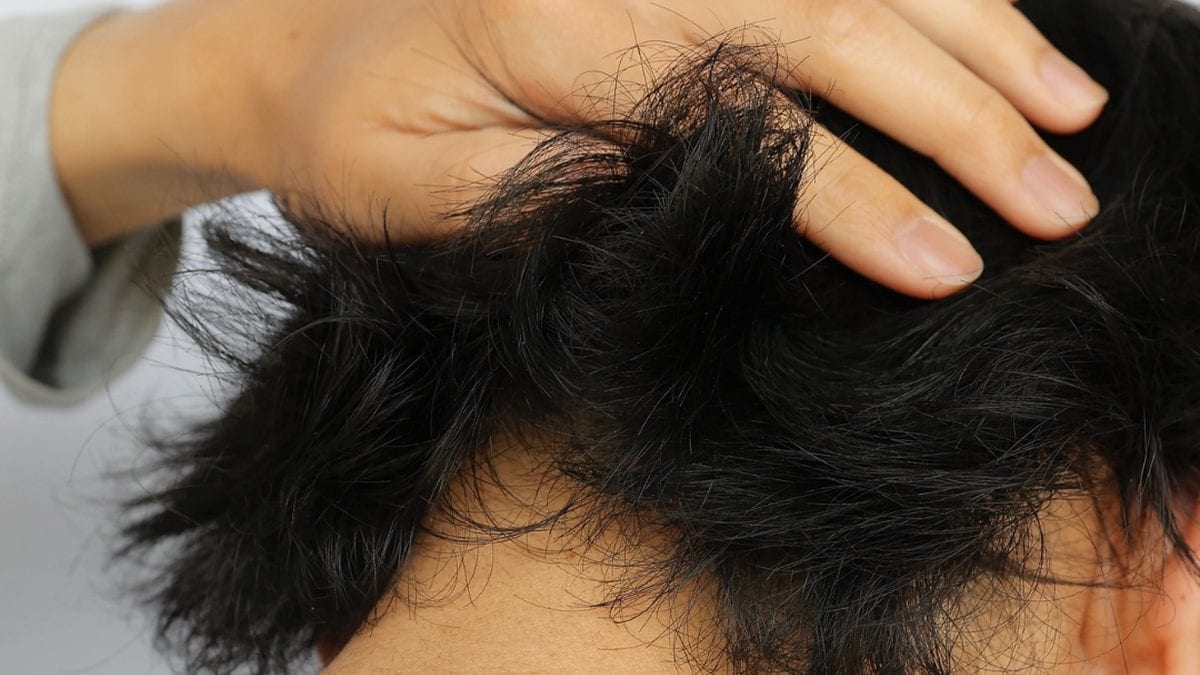
You see diffuse thinning at the back and sides, especially in harsh light or in photos taken from behind. Clusters of extractions packed close together give a moth-eaten look. With short hair, the white dot scars from FUE show. There may be a sharp line between heavily harvested and untouched skin. And you can no longer wear your hair short.
- Diffuse thinning at the back and sides. It is most obvious under a ceiling light or in a photo of the back of your head.
- A moth-eaten look. Where many extractions were taken too close together, patches form that are clearly thinner.
- White dots when the hair is short. Every FUE extraction leaves a tiny scar without pigment. At normal density the hair hides them. At low density it doesn't.
- A sharp boundary between a heavily harvested zone and an area nobody has touched.
- Short hair is no longer an option. For many people this is what they notice day to day. The result at the front turned out well, but the back of the head can't take a clipper cut.
Loss of pigment, thickened scars, skin cysts and depletion have all been described among donor area complications after FUE. Depletion is the only one with no way back.
Why doesn't overharvesting show straight after the procedure?
In the first weeks the donor area is shaved and slightly red, which hides differences in density. As the hair grows, it covers the extraction area and everything looks fine. The problem usually shows later, when you get a shorter haircut, stand in bright light or see a photo of the back of your head. That is why the donor area isn't judged finally until after about twelve months.
This is what many patients find hardest to learn after the fact. Straight after the procedure the back of the head is shaved and often reddish, which hides differences in density. Over the following months the hair grows back and lies over the area the grafts were taken from. Everything seems fine.
The reveal tends to come later. You ask your barber to go shorter, you stand under a bright light, or someone takes a photo of you from behind. By then it is many months since the grafts were taken, and the damage is there to stay.
Some people also have temporary shedding in the donor area after extraction. It settles on its own and is not the same as depletion. The only thing that tells the two apart is time. That is why an honest surgeon won't reach a verdict on donor area damage until around twelve months have passed.
Can an overharvested donor area be repaired?
No. No treatment creates a new follicle where one has been removed. Scalp micropigmentation, a form of tattooing that makes the dot scars less visible, is the most reliable way to hide the damage. Beard or body hair can sometimes add a little density, although it never quite matches scalp hair. The free option, and the one most people end up with, is to wear your hair longer.
No treatment can give you back a follicle once it has been removed. After overharvesting, the aim is to hide the damage, not to undo it.
- Scalp micropigmentation reduces the contrast between the white dots and the surrounding skin, and makes a sparse back of the head look denser when the hair is short. It is the most reliable thing you can do. Just remember it is a tattoo, not hair.
- Beard or body hair can sometimes be implanted into a depleted donor area to add density. The caveat is that these hairs don't have the same qualities as scalp hair.
- Longer hair costs nothing, and many people end up living with it.
None of this gives you back what was removed. The extraction takes hours, while the consequences last a lifetime. Because of that imbalance, caution at the back of the head matters more than any other choice in a hair transplant.
How do you avoid having your donor area overharvested?
Be on your guard if a clinic promises far more grafts than others do for the same head. Find out how densely the extractions will be placed and how large an area the grafts will be spread over. Ask what will be left for later. Ask for photos of the back of the head of the surgeon's own patients after twelve months. And don't prioritise the crown if your hair loss is still progressing.
- Be wary of record-sized sessions. If one clinic offers far more grafts than the others for the same head, a decision about your donor area has usually been made without you.
- Ask about extraction density, meaning how many grafts per cm² will be taken and how large an area they will be taken from.
- Ask what will be left for later. If the clinic says "we'll deal with that when the time comes", the plan makes no allowance for the future.
- Ask for photos of the donor area of patients the surgeon has operated on personally, taken from behind at twelve months with short hair. No request tells you more, and none is more often dodged.
- Leave the crown out of your first session if your hair loss is still progressing. No part of the head uses up grafts faster, and it is the most common reason donor areas get emptied.
Sources
- Romera de Blas C, Vega Díez D, Ricart Vayá JM, Gómez Zubiaur A. Complications in follicular unit excision hair transplantation: current evidence and practical approaches. Frontiers in Medicine, 2026;13:1750989. pubmed.ncbi.nlm.nih.gov/41709896
- Jimenez F, Ruifernández JM. Distribution of human hair in follicular units. A mathematical model for estimating the donor size in follicular unit transplantation. Dermatologic Surgery, 1999;25(4):294-298. pubmed.ncbi.nlm.nih.gov/10417585
- Rassman WR, Bernstein RM, McClellan R, Jones R, Worton E, Uyttendaele H. Follicular unit extraction: minimally invasive surgery for hair transplantation. Dermatologic Surgery, 2002;28(8):720-728. pubmed.ncbi.nlm.nih.gov/12174065
- Maas D, et al. Rethinking the occipital scalp as a control in advanced androgenetic alopecia. Journal of the American Academy of Dermatology, 2026 (ahead of print). pubmed.ncbi.nlm.nih.gov/42398778
This article summarises published research and common clinical practice. It is meant as general information and is not medical advice. Nor does it replace the advice you get from your own surgical team. If your team tells you something different from what is written here, follow your team.
Wondering what's possible for your hair?
Send three sharp photos of your hair, from the front, the top and the back. You'll get an honest answer on what can be done, roughly how many grafts it would take and what it costs.
- Free and with no obligation
- Photos are assessed by the clinic's medical team
- Replies usually within an hour in the daytime


A study tells you something about groups. Only a doctor who has seen your photos can say what applies to your hair. The medical team at the clinic at the top of our ranking offers a free assessment.
Goes to the clinic at the top of our ranking.