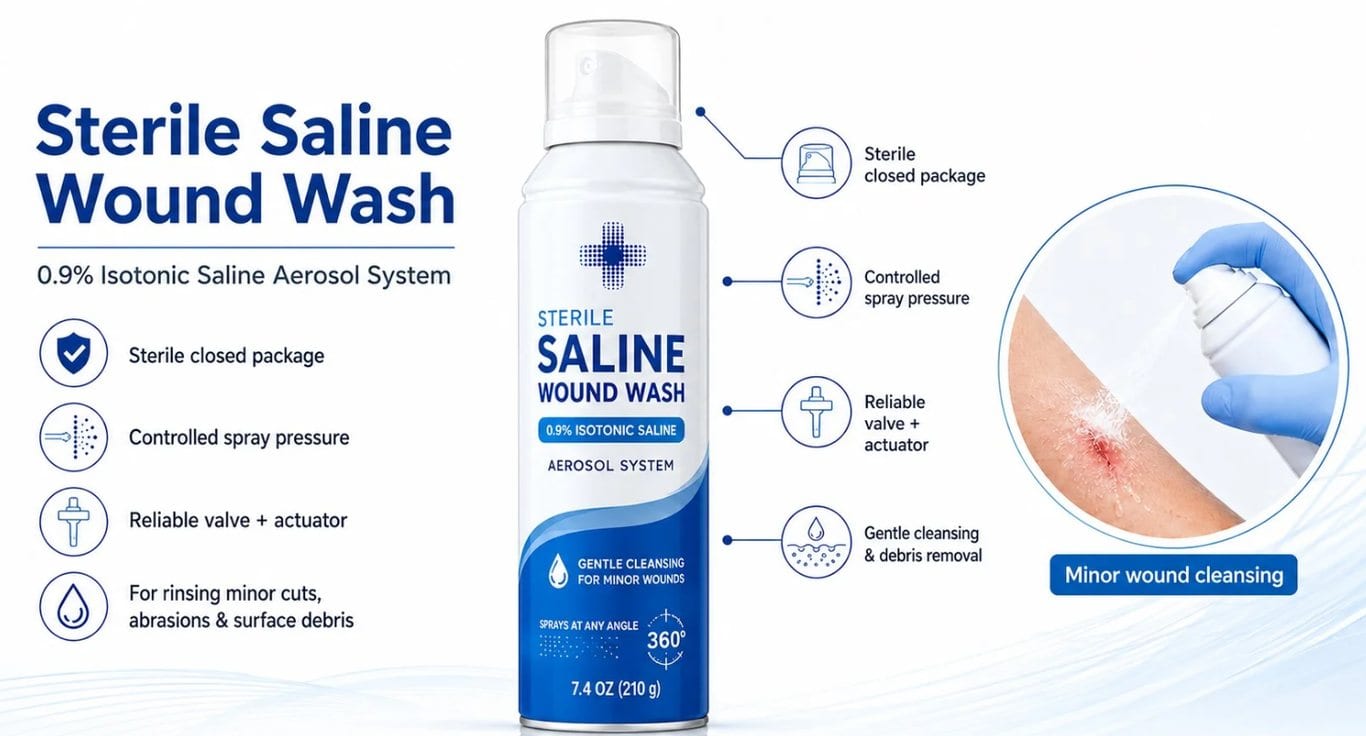
Saline spray after a hair transplant: how and why
The spray keeps the recipient area from drying out in the hours between washes during the first few days.
Between washes in the first few days, saline spray stops the recipient area from drying out. Moist scabs stay soft and come away when the time is right. Without moisture they stiffen around the graft and can pull it out when they're torn off.
What does saline spray do?
It keeps the area moist. Sterile saline has the same salt content as the body's own fluids and doesn't make wounds heal faster in itself. But when the recipient area is kept moist, the scabs don't harden. That matters, because a soft scab falls off when it's ready, while a hard one has to be pulled off, and the graft can come with it.
How often and how should you spray?
It varies between clinics, but you'll often spray lightly and frequently for the first two or three days and cut down as the scabs start to loosen. Hold the bottle some distance away, moisten the whole area evenly without soaking it, let it dry on its own, and keep going until the clinic tells you to stop, often once the scabs are gone.
The routine differs from place to place, and you follow the one your clinic has given you. The most common approach is to spray lightly and often for two or three days, then less often as the scabs come away.
- Hold the bottle far enough away to get a fine mist, not a jet
- Moisten the whole recipient area evenly, but without soaking it
- Don't wipe the area afterwards. The air does the work
- Keep going until the clinic says you can stop, often when the scabs have gone
Why does it matter so much that grafts don't dry out?
Because drying kills tissue fast. Research on graft survival found that grafts left dry outside the body during surgery began to die within minutes, not hours. That applies to grafts before they're placed and doesn't translate directly to grafts already in the scalp, but the principle holds: wounds heal better moist than dry. That's why clinics insist on soft scabs.
What doesn't work as a substitute?
Not tap water, which isn't sterile, and not a salt mix you've made yourself, because then you don't know how strong it is. Steer clear of products with alcohol, fragrance or essential oils, and don't use moisturiser or gel on the recipient area unless the clinic has approved it.
- Tap water, which isn't sterile
- Homemade saline, where you can't know the concentration
- Products with alcohol, fragrance or essential oils
- Creams or gels your clinic hasn't approved
The spray is just one part of the routine after the procedure. You'll find the full picture under aftercare.
Sources
- Bernstein RM, Rassman WR. Graft Anchoring in Hair Transplantation. Dermatologic Surgery, 2006;32(2):198-204. pubmed.ncbi.nlm.nih.gov/16442039
- Parsley WM, Perez-Meza D. Review of factors affecting the growth and survival of follicular graft. Journal of Cutaneous and Aesthetic Surgery, 2010;3(2):69-75. pubmed.ncbi.nlm.nih.gov/21031063
- Romera de Blas C, Vega Díez D, Ricart Vayá JM, Gómez Zubiaur A. Complications in follicular unit excision hair transplantation: current evidence and practical approaches. Frontiers in Medicine, 2026;13:1750989. pubmed.ncbi.nlm.nih.gov/41709896
- Kerure AS, Patwardhan N. Complications in Hair Transplantation. Journal of Cutaneous and Aesthetic Surgery, 2018;11(4):182-189. pubmed.ncbi.nlm.nih.gov/30886471
This text brings together findings from published research and standard clinical practice. It is meant as general information and is not medical advice. The instructions from the team that operated on you come first. If they tell you something different from what's written here, follow their advice.
Wondering what's possible for your hair?
Send three sharp photos of your hair, from the front, the top and the back. You'll get an honest answer on what can be done, roughly how many grafts it would take and what it costs.
- Free and with no obligation
- Photos are assessed by the clinic's medical team
- Replies usually within an hour in the daytime


A study tells you something about groups. Only a doctor who has seen your photos can say what applies to your hair. The medical team at the clinic at the top of our ranking offers a free assessment.
Goes to the clinic at the top of our ranking.