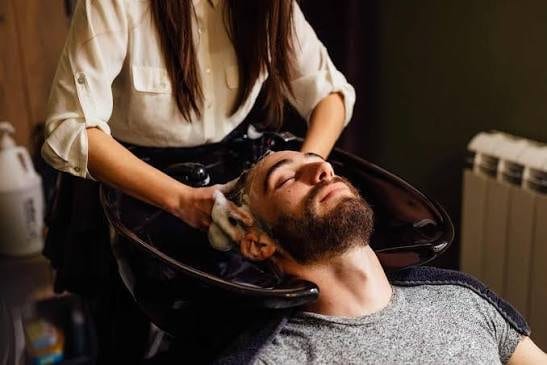
When can you wash your hair after a hair transplant?
Clinics usually let you wash gently within one to three days of the procedure. Soft scabs are safer than hard ones, so early, gentle washing protects the grafts.
Most clinics want you to start washing gently within the first few days. The reason is that scabs kept evenly soft are safer than scabs that harden. Your clinic decides the day, not a rule of thumb, and how you wash matters far more than when.
Why should you wash so early?
Because leaving the scalp alone isn't the safest option. Scabs that dry and harden grip the graft tightly and can pull it out if they catch on the pillow or a collar. Gentle daily washing keeps the scabs soft, so they come away on their own when they're ready, usually around day seven to ten and at the latest around day fourteen.
What does a typical washing plan look like?
The first gentle wash often comes within one to three days of the procedure, as the clinic advises, and after that you wash every day. Lather the shampoo in your hands, place the foam on the recipient area without pressing, rinse with a cup or a gentle shower rather than a full jet, and let the hair air-dry or pat it gently.
Routines vary, and your own clinic's routine is the one that applies. You'll often have the first gentle wash within one to three days of the procedure, as the clinic advises, frequently with a demonstration before you go home. After that you wash daily.
- Lather the shampoo you've been given in your hands. Don't squeeze it straight onto your head
- Spread the foam over the recipient area with flat fingers, with no pressure, circular movements, rubbing or nails at all
- Leave the foam on for as long as the clinic has told you, so the scabs soften
- Rinse gently: pour water from a cup, or let the shower run from a good distance. Never a full jet
- Pat lightly with a freshly washed towel or let the air do the work. The towel shouldn't be rubbed against the recipient area
- You can usually wash the donor area a bit more normally, but still gently
What mistakes do people make most in the first weeks?
They aim the shower head straight at the recipient area, use hot water, rub to get the scabs off faster or reuse the same towel. Many also start on regular shampoo and conditioner too early, or wash too rarely so the scabs harden.
- Pointing the shower head straight at the recipient area
- Water that's too hot, so the skin softens and bleeds more
- Rubbing the scabs off to get rid of them faster
- Reusing a towel after it has touched the recipient area
- Starting on regular shampoo, conditioner or styling products before the clinic has approved them
- Skipping washes, so the scabs harden
The last mistake surprises many people. Not washing feels like the careful option, but it's the hard scabs that stick to the grafts and can pull them out.
What should you avoid for two weeks?
Don't let the shower jet hit the grafts. The water should be lukewarm, not hot. Don't scrub, scratch or use your nails, skip regular shampoo and conditioner until the clinic says yes, and don't use a hairdryer on the recipient area.
- The shower jet must not hit the grafts
- Lukewarm water, not hot
- Don't scrub, scratch or use your nails
- Regular shampoo and conditioner wait until the clinic has approved them
- Keep the hairdryer away from the recipient area
What changes once the grafts have anchored?
From around day nine the grafts can no longer be dislodged, and washing can slowly return to normal. Even so, most clinics ask you to build up gradually rather than go straight to a full shower, because the skin is still healing.
Once the scabs have gone during week two, washing can gradually become more normal. The clinic will tell you when you can go back to regular shampoo.
The full routine is described in the aftercare guide.
Sources
- Bernstein RM, Rassman WR. Graft Anchoring in Hair Transplantation. Dermatologic Surgery, 2006;32(2):198-204. pubmed.ncbi.nlm.nih.gov/16442039
- Romera de Blas C, Vega Díez D, Ricart Vayá JM, Gómez Zubiaur A. Complications in follicular unit excision hair transplantation: current evidence and practical approaches. Frontiers in Medicine, 2026;13:1750989. pubmed.ncbi.nlm.nih.gov/41709896
- Zhou Y, Zhang J, Yi Y, Xie X, Lei R, Fan Z, et al. Characterization and Risk Factors of Folliculitis after Hair Transplantation: A Multicenter Retrospective Study. Plastic and Reconstructive Surgery, 2024;154(6):1115e-1122e. pubmed.ncbi.nlm.nih.gov/37904273
- Zhang J, Zhao Y, Zhang J, Zhou Y, Yi Y, Lei R, et al. Risk Factors and Hazards of Recipient-Area Perifollicular Erythema After Hair Transplantation: A Multicenter Retrospective Cohort Study. Aesthetic Plastic Surgery, 2024;48(15):2771-2777. pubmed.ncbi.nlm.nih.gov/38849551
- Vañó-Galván S, Bisanga CN, Bouhanna P, Farjo B, Gambino V, Meyer-González T, Silyuk T; Hair Transplant Surgery Expert Group. An international expert consensus statement focusing on pre and post hair transplantation care. Journal of Dermatological Treatment, 2023;34(1):2232065. pubmed.ncbi.nlm.nih.gov/37477225
This text brings together findings from published research and standard clinical practice. It is meant as general information and is not medical advice. The instructions from the team that operated on you come first. If they tell you something different from what's written here, follow their advice.
Wondering what's possible for your hair?
Send three sharp photos of your hair, from the front, the top and the back. You'll get an honest answer on what can be done, roughly how many grafts it would take and what it costs.
- Free and with no obligation
- Photos are assessed by the clinic's medical team
- Replies usually within an hour in the daytime


A study tells you something about groups. Only a doctor who has seen your photos can say what applies to your hair. The medical team at the clinic at the top of our ranking offers a free assessment.
Goes to the clinic at the top of our ranking.