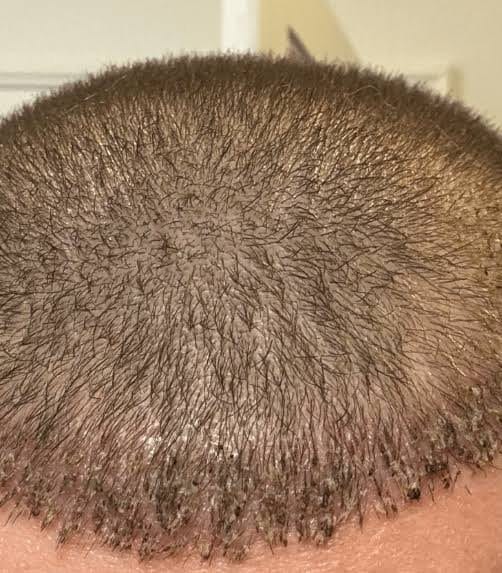
Scabs after a hair transplant: when do they fall off on their own?
Scabs usually fall off on their own around days seven to ten, and by about day fourteen at the latest. They are the grafts' last shield against the outside world, so knowing the timeline makes it easier to keep your fingers off them.
Scabs form within about 24 hours and usually come off around days seven to ten, by about day fourteen at the latest. They matter because they are stuck to the graft underneath. Research on graft anchoring found that a scab pulled off could take the graft with it as late as day five. The risk from tugging on the hair passes sooner than that. The point of the first washes is to soften the scabs so they loosen on their own.
What are the scabs made of?
Blood and tissue fluid that dry around each transplanted hair. That is why the recipient area gets hundreds or thousands of tiny scabs, one for each graft. They are a perfectly normal wound covering that protects the graft. The only problem is that each scab is stuck to its graft and so acts like a handle.
When do the scabs usually fall off?
They start forming after about a day, are fully formed after two or three days and usually come off around days seven to ten, by about day fourteen at the latest, unevenly across the scalp. When a scab loosens, the visible hair shaft usually comes with it. It looks dramatic, but the follicle stays under the skin and grows new hair later.
Most people get their first scabs after about a day, and after two or three days they are all in place. Then they gradually soften and come off, usually around days seven to ten, by about day fourteen at the latest.
By the end of the second week, the recipient area is almost clear for most people. It doesn't happen at the same pace everywhere. One area can be free of scabs on day eight while another keeps them until after day twelve. This patchy pattern is common and doesn't mean anything is wrong.
Why the hair comes off too
When a scab loosens, it often takes the hair shaft poking through it along with it. Many people panic and think the transplant is falling out. It isn't. The shaft is lost, but the follicle sits safely under the skin and starts producing again once the resting phase is over.
Why can you lose a graft if you pick a scab off too early?
Because the scab holds on to the graft for longer than the hair does. Bernstein and Rassman studied 42 patients and found that pulling on a hair only dislodged grafts on days 0 to 2, whereas an attached scab could pull the graft out as late as day five. So scabs extend the period when grafts are vulnerable, and they are the risk that lasts longest.
Bernstein and Rassman's study of graft anchoring, with 42 participants, ended up with two different risk timelines. The gap between them is the very reason this article exists.
- Pulling on a hair made the graft come loose during the first two days. From day six it was safe.
- An attached scab that was pulled off led to a lost graft as late as day five.
The authors pointed out that scabs lengthen the window in which grafts can come loose. So the scab is the risk that hangs around longest. It is also the one you're most tempted to remove, since it looks like debris.
How do you get the scabs to come off on their own?
By softening them evenly with washing in the first days. Apply water and lather by hand without aiming the shower jet at the area. Don't rub, don't scrub, and keep the towel away. Saline or the spray you've been prescribed keeps the scabs soft between washes.
The washing clinics ask you to do in the first days is less about getting clean and more about softening the scabs evenly. That way they come off when they should, instead of hardening and getting stuck to the pillowcase.
- Start washing when your clinic tells you to, not by some random rule from the internet. Routines vary from place to place.
- Spread water and lather lightly by hand. Don't let the shower jet hit the recipient area directly.
- Don't rub, scrub or towel-dry the recipient area. Pat it gently or let it air-dry.
- Between washes, saline or the prescribed spray keeps the scabs soft.
- Expect the scabs to disappear bit by bit over several days.
The full routine from the first to the last week is in the aftercare guide.
Which scabs are not normal?
Tell your clinic if scabs reappear after the area was clear, if they are thick, yellow or weeping when they should be dry and dark, if you also get a fever or more redness, warmth and tenderness, or if no scabs have come off after about two weeks. It can mean infection or folliculitis. A doctor can treat both. Picking doesn't help.
If your scabs differ from what is described above, your clinic should know:
- New scabs after the area had become clear
- Scabs that are thick, yellow or weeping when they should be dry and dark
- Scabs together with fever or increasing redness, tenderness and warmth
- No scabs have loosened after about two weeks
Signs like these can point to infection or folliculitis. Both can be treated, but picking is not the treatment for either.
Sources
- Bernstein RM, Rassman WR. Graft Anchoring in Hair Transplantation. Dermatologic Surgery, 2006;32(2):198-204. pubmed.ncbi.nlm.nih.gov/16442039
- Romera de Blas C, Vega Díez D, Ricart Vayá JM, Gómez Zubiaur A. Complications in follicular unit excision hair transplantation: current evidence and practical approaches. Frontiers in Medicine, 2026;13:1750989. pubmed.ncbi.nlm.nih.gov/41709896
- Zhou Y, Zhang J, Yi Y, Xie X, Lei R, Fan Z, et al. Characterization and Risk Factors of Folliculitis after Hair Transplantation: A Multicenter Retrospective Study. Plastic and Reconstructive Surgery, 2024;154(6):1115e-1122e. pubmed.ncbi.nlm.nih.gov/37904273
- Kerure AS, Patwardhan N. Complications in Hair Transplantation. Journal of Cutaneous and Aesthetic Surgery, 2018;11(4):182-189. pubmed.ncbi.nlm.nih.gov/30886471
This text brings together findings from published research and standard clinical practice. It is general information and not medical advice. The instructions from the team that operated on you come first. If they tell you something different from what is written here, follow their advice.
Wondering what's possible for your hair?
Send three sharp photos of your hair, from the front, the top and the back. You'll get an honest answer on what can be done, roughly how many grafts it would take and what it costs.
- Free and with no obligation
- Photos are assessed by the clinic's medical team
- Replies usually within an hour in the daytime


A study tells you something about groups. Only a doctor who has seen your photos can say what applies to your hair. The medical team at the clinic at the top of our ranking offers a free assessment.
Goes to the clinic at the top of our ranking.