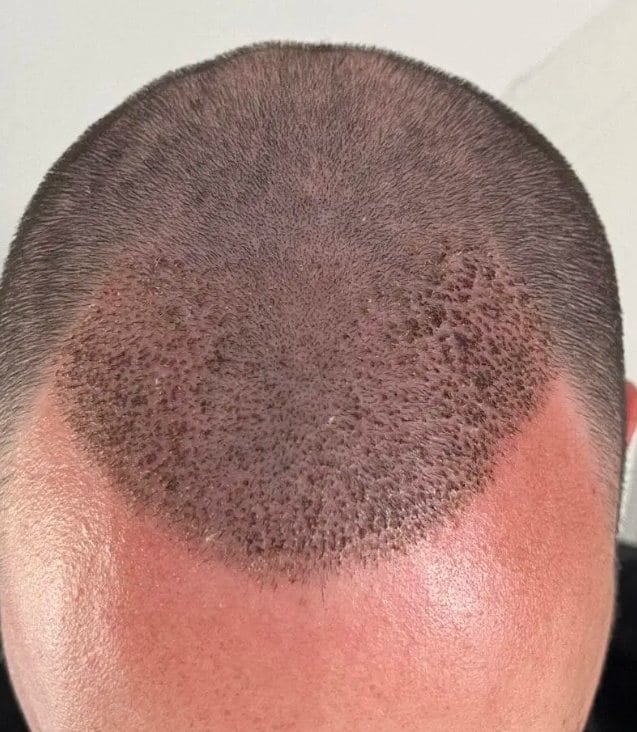
Did a scab come off too early? How to tell if the graft went with it
Usually you can tell. A scab that was ready comes off dry, painlessly and without blood, while one that came off too early clings, stings and leaves a small drop of blood.
A scab that is ready comes off dry and painlessly, and there's no bleeding. If it's pulled off too soon, you feel it clinging, it stings, a small drop of blood appears, and sometimes there's a tiny white bulb on it. Research on how grafts anchor found that an attached scab could take the graft with it as late as day five, so telling the difference matters most during week one.
Can you tell if a scab took a graft with it?
Usually, yes. Few people pull scabs off on purpose. What usually happens is that a scab catches on the pillowcase or comes off in the shower, and then you wonder whether the graft went with it. A scab that has done its job loosens in a completely different way from one that was still stuck to the graft.
How does a scab behave when it's ready to come off?
It slides off without clinging, without pain and without blood, and the skin underneath is pink and intact. If a hair comes with it, the root end is bare. Losing the hair shaft doesn't mean the graft is lost, because the shaft is shed as a normal part of the process while the follicle stays put.
- The scab loosens easily, often while you wash or dry yourself
- You feel no pain
- No bleeding
- Underneath is pink, undamaged skin
- A hair may come with it, but with nothing on the end
A hair that falls out on its own is not a lost graft. The follicle pushes it out as part of the shedding that always follows the procedure, and the follicle itself stays in the skin.
What does it look like when a scab was pulled off too early?
The scab clings when you lift it, there's a sharp sting at one spot, and you see a tiny drop of blood. At the root you may see a tiny white or glassy bulb of follicle tissue, or there may be a small empty pit where the graft sat. Blood and a bulb together are the surest sign that a graft has come out.
- It clings. The scab won't let go, you have to pull.
- It hurts. A sharp sting right at that spot.
- A small spot of blood. Afterwards you see a red dot of fresh blood.
- A bulb at the root. At the bottom of the hair in the scab you see a minute white or glassy thickening. That is follicle tissue.
- A hole. A small pit or opening where the graft was.
If you see both blood and a bulb like this, it is most likely the graft that came out, not just the scab.
When is the risk of losing a graft with a scab highest?
In the first five days. An attached scab could pull a graft loose as late as day five. A tug on the hair was harmless from day six, and after day nine the grafts were completely secure. If you have a mishap during the first five days, keep an eye on it. If you lose a scab after day nine, nothing happens to the grafts.
What should you do if a graft came off with the scab?
Stay calm. One or two grafts out of several thousand won't change the result. Leave the area alone, press a sterile gauze pad lightly on the spot if it bleeds, and wash as before. Call your clinic if more than one graft comes out or if the bleeding doesn't stop.
One lost graft is not a crisis. Thousands are placed in a session, and a few lost in the first fourteen days make little difference to the final result. Respond just as calmly.
- Keep your fingers off, and don't dig around with tweezers to check.
- If it bleeds, press a sterile gauze pad lightly on the spot. Don't rub.
- Carry on with saline and washing as you've been told.
- Take a photo if you like, so the clinic can see what happened.
- Call your clinic if more than one graft has fallen out, if light pressure doesn't stop the bleeding, or if you're unsure.
The most important thing is to remove the cause. It might be your pillow, a hat or the way you dry your hair.
How the scabs loosen depends mostly on how you wash. The method is in the aftercare routine.
Sources
- Bernstein RM, Rassman WR. Graft Anchoring in Hair Transplantation. Dermatologic Surgery, 2006;32(2):198-204. pubmed.ncbi.nlm.nih.gov/16442039
- Kerure AS, Patwardhan N. Complications in Hair Transplantation. Journal of Cutaneous and Aesthetic Surgery, 2018;11(4):182-189. pubmed.ncbi.nlm.nih.gov/30886471
- Romera de Blas C, Vega Díez D, Ricart Vayá JM, Gómez Zubiaur A. Complications in follicular unit excision hair transplantation: current evidence and practical approaches. Frontiers in Medicine, 2026;13:1750989. pubmed.ncbi.nlm.nih.gov/41709896
This text brings together findings from published research and standard clinical practice. It is general information and not medical advice. The instructions from the team that operated on you come first. If they tell you something different from what is written here, follow their advice.
Wondering what's possible for your hair?
Send three sharp photos of your hair, from the front, the top and the back. You'll get an honest answer on what can be done, roughly how many grafts it would take and what it costs.
- Free and with no obligation
- Photos are assessed by the clinic's medical team
- Replies usually within an hour in the daytime


A study tells you something about groups. Only a doctor who has seen your photos can say what applies to your hair. The medical team at the clinic at the top of our ranking offers a free assessment.
Goes to the clinic at the top of our ranking.