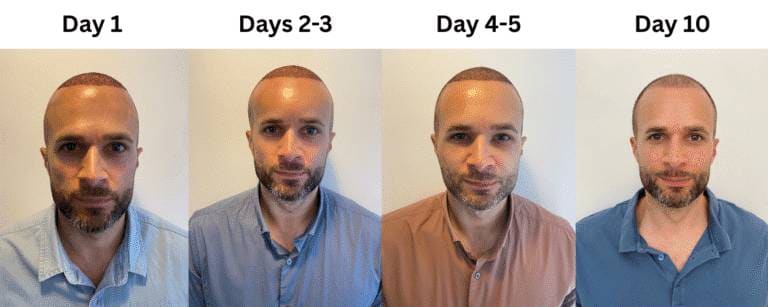
How does a hair transplant heal from day 1 to day 14?
What happens in your scalp during the two weeks that decide how many of the grafts stay put.
During the first fourteen days, a graft can still be pulled loose. After that, it can't. Research on how grafts anchor showed that a tug on the hair dislodged the graft during the first two days, and that a stuck scab could take the graft with it as late as day five. From day six, the graft no longer came loose when someone pulled the hair, and from day nine the risk was over. All the advice on washing, sleeping and exercise after the procedure rests on this timeline.
Why are the first two weeks so crucial?
Because a newly implanted graft has no blood supply of its own and is held in place only by clotted blood and the surrounding tissue. That means it can be pulled out. Bernstein and Rassman followed 42 patients and pulled on grafts at set intervals until they were firmly fixed, and clinics' aftercare plans are built on that work.
When the follicle is implanted, it isn't attached to anything. It sits in a small opening, held by clotted blood and by the pressure of the surrounding tissue, and it has no blood supply until the scalp has made a new one. Until then, the graft can be pulled out.
That's why you're sent home with instructions. The scalp isn't especially fragile in general. But there's a measurable period when outside forces can dislodge grafts, and a point when that stops.
That period has been measured. In the work by Bernstein and Rassman, grafts in 42 patients were deliberately pulled, day after day, until they were anchored so well they wouldn't budge. The answers below come from there, and so does the timetable most clinics give their patients.
What happens to the grafts on days 0 to 2?
The grafts are at their loosest now. In the study, the graft came out every single time someone pulled a new hair on days 0 to 2, so the strictest rules apply: don't touch the area, no tight hats and no towel drying. The area is raw and pink, the first scabs appear after about a day, and the forehead isn't swollen yet.
At the start, on days 0 to 2, a tug on a new hair every time made the graft come out with it. Not occasionally. Every time.
Now you need to be extra careful. Don't touch the recipient area, don't wear a hat that pulls on the grafts or presses them down, don't sleep on your front and don't use a towel. If anything pulls on a hair now, the force goes straight to a follicle with nothing holding it.
What it looks like
The skin is raw and pink, with small dots of dried blood around each graft. After about a day, scabs start to form. The donor area, whether punched out or stitched, is usually more painful than the recipient area at this point.
The swelling is still to come
The forehead usually isn't swollen yet. It tends to show up a little later, which surprises many people who expect day one to be the worst.
What poses the biggest threat to grafts on days 3 to 5?
The scabs, because each scab is glued to the follicle beneath it. The grafts sit more firmly now, but if you tear off a stuck scab, the graft can still come with it. Gentle washing usually starts now to soften the scabs safely, and swelling from the anaesthetic fluid tends to be worst around days two, three and four.
The grafts have started to settle, but the study revealed a risk that lingers longer than the obvious one: a stuck scab that was torn off still took the graft with it as late as day five.
This is where many patients go wrong. Everyone understands it's a bad idea to pull on the hair. Fewer realise that picking at scabs is risky for several more days. The scab is stuck to the graft, so when one is lifted, the other comes too.
Most clinics let you start gentle washing during these days. Soft scabs are safer than hard scabs that catch on the pillow or a jumper collar.
Swelling peaks now
The forehead, and sometimes the eyelids, tends to swell on day two, three or four and improves in the days after. The swelling comes from anaesthetic fluid and tissue fluid after the procedure. Gravity pulls the fluid downwards, so it drifts from the hairline down towards the eyebrows rather than staying where you were operated on.
Are the grafts safe on days 6 to 8?
Largely, yes. From day six, the graft no longer comes loose if someone pulls the hair, because the follicle has started to grow into the surrounding tissue. The scabs are still stuck, though, so you need to wash gently. The recipient area looks calmer, and the donor area may feel numb. That usually wears off after a few weeks, sometimes only after a few months.
From day six, the study found that a tug on the hair no longer made the graft come loose. The follicle has begun to attach to the surrounding tissue.
That's an important milestone, but you're not done yet. The scabs are still stuck, and they're what can now pull grafts out. Keep washing calmly and carefully, not with a heavy hand.
For most people, the recipient area looks less irritated now, and the redness fades in patches. In the donor area, sensation may be reduced or odd. That's common, and it's usually gone within a few weeks or months.
From which day can grafts no longer fall out?
From day nine. From then on, the researchers found no grafts that came loose, and the risk of losing them mechanically is over. That doesn't mean the rest of the healing is finished. Redness, the advice on sun and sweating, and the risk of infection each follow their own timeline.
What does the scalp look like on days 10 to 14?
The scabs usually come off during this period, taking the visible transplanted hair shafts with them. That's expected and not a sign of lost grafts, because the follicle stays in place. By the time fourteen days have passed, the recipient area is usually pink and almost free of scabs, the donor area has closed at the surface, and the swelling has settled.
The scabs from the first few days usually come off around days seven to ten, at the latest around day fourteen, and they take the short stubble of new hair you can see with them. By the end of the second week, most people are largely free of scabs.
These hairs falling out is perfectly fine, and the grafts aren't lost. The shaft goes, but the follicle stays. Then comes a resting phase before new hair starts to grow, which is described in the guide to aftercare and recovery.
What's normal after fourteen days
- The recipient area is pink or slightly red, with no scabs or just a few remnants
- Most or all of the transplanted hair shafts have fallen out
- The donor area has closed, but may still feel numb or tight
- The swelling is gone
When should you call the clinic?
Get in touch straight away if redness, warmth or pain increases instead of easing, if pus appears or scabs come back after they'd gone, if you get a fever, if swelling spreads or appears late, or if a graft has clearly come out, especially during week one. Infection is rare after a transplant but must be treated quickly.
The timeline above applies when everything goes as it should. These signs are not part of the normal picture. Report them rather than waiting:
- Redness, warmth or pain that increases after the first few days, when it should have eased gradually
- Pus, or scabs that reappear after they'd gone
- Fever
- Swelling that spreads, or that comes late in the course
- A graft that has clearly fallen out, especially in the first week
Infection after a hair transplant is rare, but it should be treated quickly. Call the clinic. If you've come home from abroad and can't get an answer right away, go to your GP (fastlege) or the out-of-hours service (legevakt) rather than waiting.
Sources
- Bernstein RM, Rassman WR. Graft Anchoring in Hair Transplantation. Dermatologic Surgery, 2006;32(2):198-204. pubmed.ncbi.nlm.nih.gov/16442039
- Romera de Blas C, Vega Díez D, Ricart Vayá JM, Gómez Zubiaur A. Complications in follicular unit excision hair transplantation: current evidence and practical approaches. Frontiers in Medicine, 2026;13:1750989. pubmed.ncbi.nlm.nih.gov/41709896
- Kerure AS, Patwardhan N. Complications in Hair Transplantation. Journal of Cutaneous and Aesthetic Surgery, 2018;11(4):182-189. pubmed.ncbi.nlm.nih.gov/30886471
- Parsley WM, Perez-Meza D. Review of factors affecting the growth and survival of follicular graft. Journal of Cutaneous and Aesthetic Surgery, 2010;3(2):69-75. pubmed.ncbi.nlm.nih.gov/21031063
This text brings together findings from published research and common clinical practice. It is meant as general information and is not medical advice. The instructions from the team that operated on you come first. If they tell you something different from what's written here, follow their advice.
Wondering what's possible for your hair?
Send three sharp photos of your hair, from the front, the top and the back. You'll get an honest answer on what can be done, roughly how many grafts it would take and what it costs.
- Free and with no obligation
- Photos are assessed by the clinic's medical team
- Replies usually within an hour in the daytime


A study tells you something about groups. Only a doctor who has seen your photos can say what applies to your hair. The medical team at the clinic at the top of our ranking offers a free assessment.
Goes to the clinic at the top of our ranking.