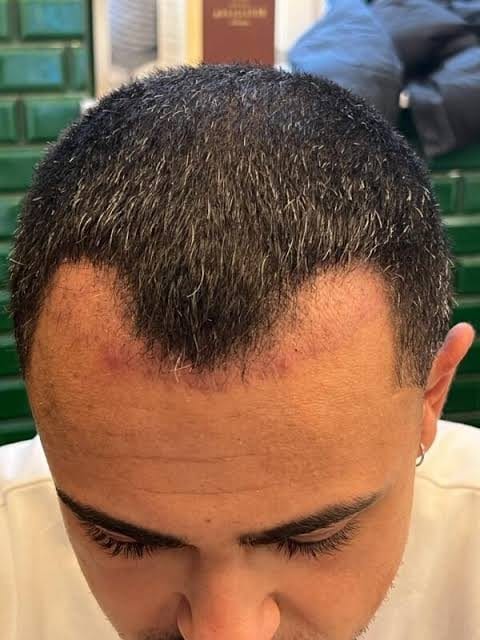
Shock loss: why you lose your own hair after a transplant
With shock loss you temporarily lose some of the hair you already had, in or near the treated area. The strain of the procedure pushes the follicles into their resting phase too early.
With shock loss you temporarily lose some of the hair you already had, in or around the treated area. The strain of the procedure pushes the follicles into their resting phase too early. It usually grows back, and it isn't the same as the transplanted hairs falling out.
What is shock loss?
It's when the strain of the procedure (the incisions, the anaesthetic, the swelling and the altered blood supply) makes your own hair leave its growth phase and go into rest too early. Many follicles enter the resting phase at the same time and so shed their hairs at the same time a few weeks later. That's why the loss feels sudden and dramatic rather than gradual.
Is shock loss the same as the new hairs falling out?
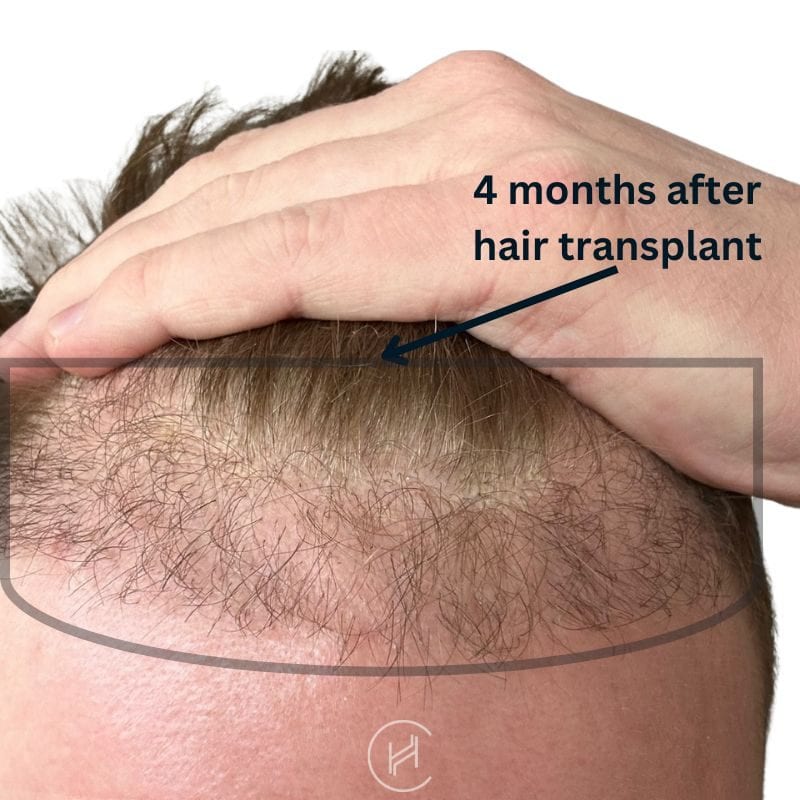
No. The new hairs falling out early on happens to almost everyone, and the follicle stays in the skin. Shock loss affects the hair you already had around the recipient or donor area, and it only happens to some people. Both are almost always temporary, and neither means the procedure has failed.
- The new hairs fall out. During the first few weeks, the hairs from the newly placed grafts shed. This happens to almost everyone, and the follicle stays behind.
- Shock loss. You lose some of your original hair around the recipient area or the donor area. Not everyone gets it, and it shows most when there was still a fair amount of your own hair where the surgery took place.
In the vast majority of cases both are temporary, and neither is a sign of a failed procedure.
Who is most likely to get shock loss?
People with a lot of miniaturised native hair where the grafts are going, because weakened follicles go into rest most easily. The risk also rises with large sessions and dense placement. Women are affected more often, since their thinning tends to be diffuse and there's more of their own hair left to fall, and the same applies to people who are already losing hair quickly.
- People with a lot of miniaturised hair in the recipient area. Weakened follicles are the first to go into rest
- Large sessions with densely placed grafts
- Women, who more often have diffuse thinning than fully bald areas, and therefore more of their own hair that can fall
- People whose hair loss is already progressing quickly
Does the hair come back after shock loss?
Usually, yes. The follicles that were pushed into rest start a new growth phase, and the hair is back within a few months. The exception is hairs that were already heavily miniaturised. There, the procedure can be the last straw for a follicle that was on its way out anyway, and the procedure reveals a loss that was already under way rather than causing it. That's why medical treatment alongside surgery is often recommended.
Sources
- Romera de Blas C, Vega Díez D, Ricart Vayá JM, Gómez Zubiaur A. Complications in follicular unit excision hair transplantation: current evidence and practical approaches. Frontiers in Medicine, 2026;13:1750989. pubmed.ncbi.nlm.nih.gov/41709896
- Kerure AS, Patwardhan N. Complications in Hair Transplantation. Journal of Cutaneous and Aesthetic Surgery, 2018;11(4):182-189. pubmed.ncbi.nlm.nih.gov/30886471
- Okochi H, Onda M, Momosawa A, Okochi M. An Analysis of Risk Factors of Recipient Site Temporary Effluvium After Follicular Unit Excision: A Single-Center Retrospective Study. Aesthetic Plastic Surgery, 2024;48(7):1258-1263. pubmed.ncbi.nlm.nih.gov/37816944
This text brings together findings from published research and standard clinical practice. It is meant as general information and is not medical advice. The instructions from the team that operated on you come first. If they tell you something different from what's written here, follow their advice.
Wondering what's possible for your hair?
Send three sharp photos of your hair, from the front, the top and the back. You'll get an honest answer on what can be done, roughly how many grafts it would take and what it costs.
- Free and with no obligation
- Photos are assessed by the clinic's medical team
- Replies usually within an hour in the daytime


A study tells you something about groups. Only a doctor who has seen your photos can say what applies to your hair. The medical team at the clinic at the top of our ranking offers a free assessment.
Goes to the clinic at the top of our ranking.