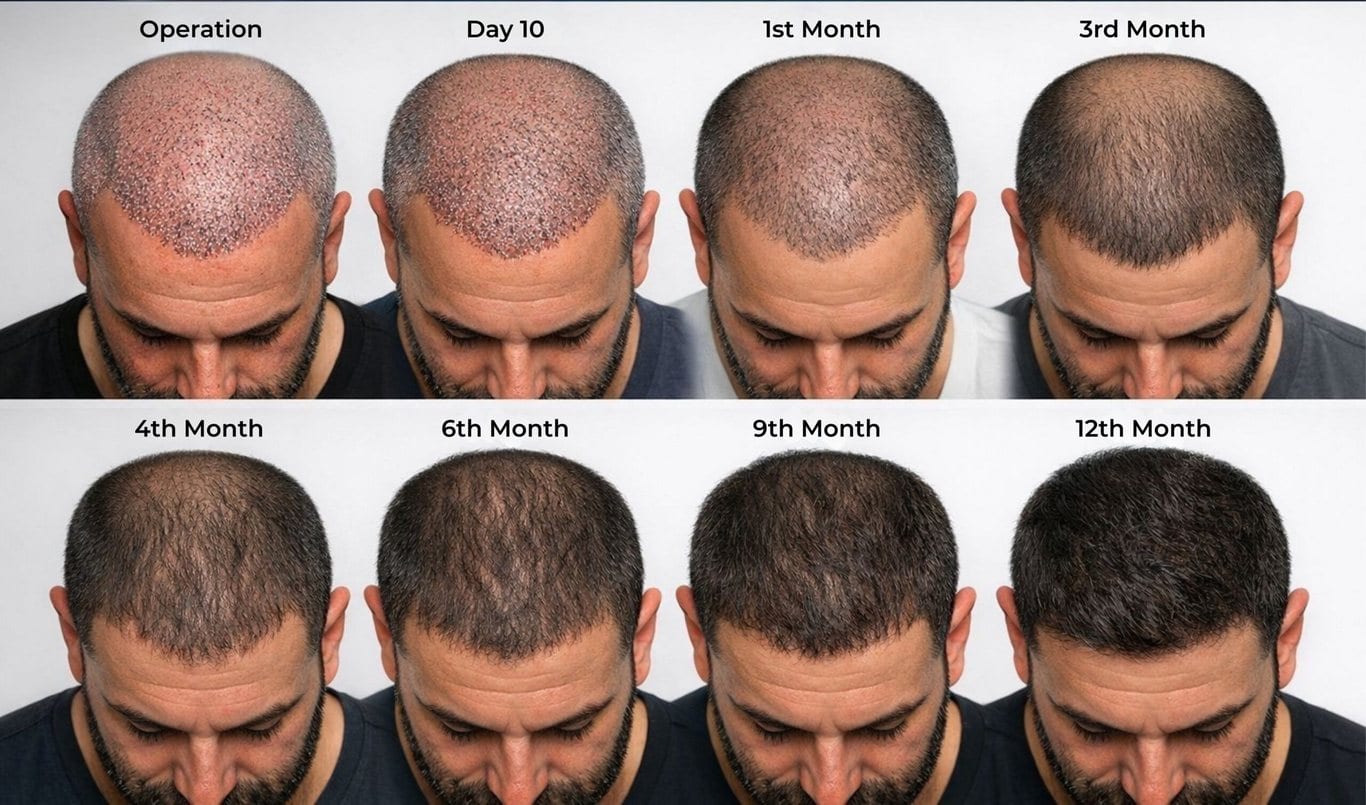
Hair transplant healing week by week: what happens in weeks 1 to 8?
The first eight weeks fall into three phases: two weeks when the grafts are vulnerable, a quiet spell when the new hairs fall out, and finally the first signs that something is growing.
After the procedure, the scalp goes through three phases in the first eight weeks. For the first fourteen days the grafts can still be pulled loose. Then comes a quiet period when the transplanted hairs fall out, before the first shoots of new growth appear. Knowing where you are in the process makes it easier not to read perfectly normal things as a failed procedure.
What happens in the first two weeks?
These are the only weeks when a graft can come loose. A tug on the hair could dislodge the graft in the first two days, and an attached scab could take it with it as late as day five. From day nine they're secure. Scabs usually come off around days seven to ten, by about day fourteen at the latest, and swelling is greatest around days two to four.
Only in these two weeks can a graft physically be lost. Research on how grafts anchor found that they came loose when someone pulled on the hair on days 0 to 2, that an attached scab could pull the graft out right up to day five, and that the risk was over from day nine.
Scabs form during the first or second day and most often come off between days seven and fourteen. Swelling appears around day two, three or four and goes within the week. It's usually the donor area that bothers people most.
Why are the new hairs gone after a month?
Because the follicles go into a resting phase after being moved. The hairs usually shed during the second and third weeks, and by the end of week 4 most people have lost almost all of them. The follicles themselves stay in the skin. The scalp can look thinner than before the procedure, and that's normal. Increasing redness, pus or pain, however, are not part of it.
What happens from week 5 to the end of week 8?
Not much that you can see. Redness in the recipient area keeps fading towards your normal skin tone, faster if you have fair skin and more slowly if you have darker skin. Your own hair lost to shock loss often starts growing back. Some see a little fine new growth towards the end of this period, many see nothing yet.
To the eye, little happens. The recipient area gradually becomes less pink and closer to your usual skin tone. It's quicker for fair skin than for darker skin. A few people see the first fine hairs towards the end of week eight, but most have to wait longer.
If you lost some of your original hair to shock loss, it usually comes back during these weeks.
| Recipient area | Redness fading, but not evenly everywhere |
|---|---|
| Donor area | Healed, perhaps still a little numb |
| New growth | Little or nothing to see yet |
| Scabs | Gone |
What's the best way to track your progress?
With photos every four weeks in the same light, not by studying yourself in the mirror every day. At eight weeks it's far too early to judge anything. The usual course is that the hairs shed during the second and third weeks, new growth comes in the third or fourth month, and the final result is in place after around twelve months. The mirror fools you with changing light and hair length.
The full week-by-week routine is in the aftercare guide.
Sources
- Bernstein RM, Rassman WR. Graft Anchoring in Hair Transplantation. Dermatologic Surgery, 2006;32(2):198-204. pubmed.ncbi.nlm.nih.gov/16442039
- Romera de Blas C, Vega Díez D, Ricart Vayá JM, Gómez Zubiaur A. Complications in follicular unit excision hair transplantation: current evidence and practical approaches. Frontiers in Medicine, 2026;13:1750989. pubmed.ncbi.nlm.nih.gov/41709896
- Vañó-Galván S, Bisanga CN, Bouhanna P, Farjo B, Gambino V, Meyer-González T, Silyuk T; Hair Transplant Surgery Expert Group. An international expert consensus statement focusing on pre and post hair transplantation care. Journal of Dermatological Treatment, 2023;34(1):2232065. pubmed.ncbi.nlm.nih.gov/37477225
This text brings together findings from published research and standard clinical practice. It is general information and not medical advice. The instructions from the team that operated on you come first. If they tell you something different from what is written here, follow their advice.
Wondering what's possible for your hair?
Send three sharp photos of your hair, from the front, the top and the back. You'll get an honest answer on what can be done, roughly how many grafts it would take and what it costs.
- Free and with no obligation
- Photos are assessed by the clinic's medical team
- Replies usually within an hour in the daytime


A study tells you something about groups. Only a doctor who has seen your photos can say what applies to your hair. The medical team at the clinic at the top of our ranking offers a free assessment.
Goes to the clinic at the top of our ranking.