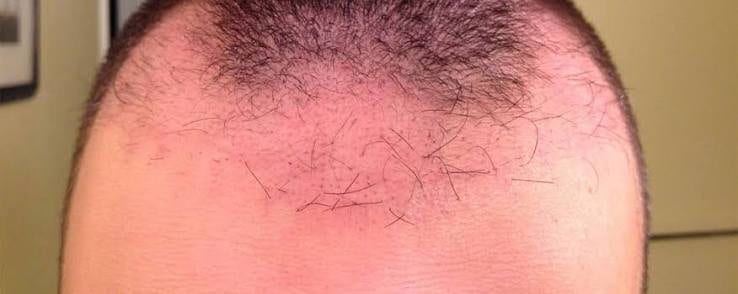
Shock loss: how long until the hair grows back?
Shock loss usually shows up within two months and recovers over the following three to six. The hair's own cycle sets the pace, not any treatment.
Shock loss usually shows up within two months of the procedure, and it recovers over the following three to six months. The pace is set by the hair's own cycle, not by anything you use. The wait is hard, but there are rarely surprises in how it plays out.
Why does it take months, not weeks?
Because the follicle has to go through its whole cycle. Once it has been pushed into rest, it has to finish the resting phase and shed the hair. Then a new growth phase starts, and the new hair has to grow long enough for you to see it. That takes months, and there's no product that shortens it.
How does shock loss progress, month by month?
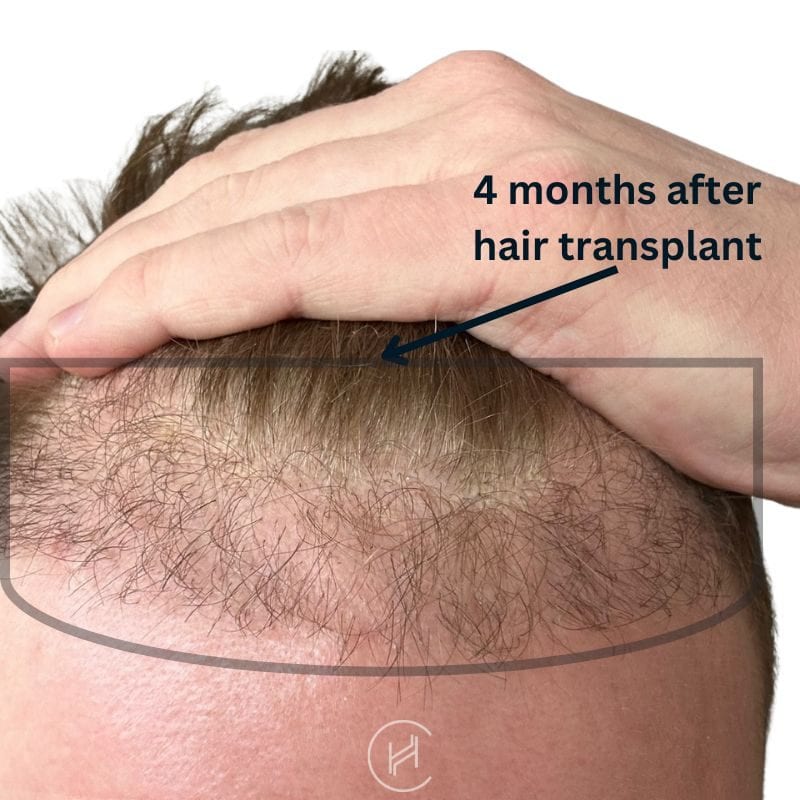
You notice your own hair falling somewhere between week two and week eight. In months two to four it levels off, density is at its lowest, and the area can look worse than before the procedure. New, thin and short hairs appear in months three to six, and from month six to twelve the hair regains thickness and length.
| When | What happens |
|---|---|
| Weeks 2 to 8 | You start to notice your own hair falling out |
| Months 2 to 4 | The shedding levels off. Density is at its lowest, and many people think it looks worse than when they started |
| Months 3 to 6 | New hairs appear, thin and short at first |
| Months 6 to 12 | The hair gets thicker and longer and catches up with the transplanted hairs |
Why are months three and four so hard?
Because two losses overlap. The hairs from the grafts have gone and haven't grown back yet, and the original hair that went into rest isn't there either. For now, none of it is growing back. This is when many people think the procedure has failed, even though it's usually now that the new growth gets going.
When is it more than shock loss?
If the shedding lasts longer than six months with nothing new growing, if it spreads well beyond the area that was operated on, if you get pain, flaking or pustules on the scalp, or if the donor area gets thinner instead of better. Then a professional should look at it before you let more time pass.
- The shedding continues after six months, and nothing new is growing
- You're losing hair well outside the area that was treated
- You also have pain, flaking or pustules on the scalp
- The donor area gets visibly thinner instead of recovering
Have it checked by a professional straight away, because the cause may be something else that needs a diagnosis.
Sources
- Romera de Blas C, Vega Díez D, Ricart Vayá JM, Gómez Zubiaur A. Complications in follicular unit excision hair transplantation: current evidence and practical approaches. Frontiers in Medicine, 2026;13:1750989. pubmed.ncbi.nlm.nih.gov/41709896
- Kerure AS, Patwardhan N. Complications in Hair Transplantation. Journal of Cutaneous and Aesthetic Surgery, 2018;11(4):182-189. pubmed.ncbi.nlm.nih.gov/30886471
- Garg AK, Garg S. Complications of Hair Transplant Procedures-Causes and Management. Indian Journal of Plastic Surgery, 2021;54(4):477-482. pubmed.ncbi.nlm.nih.gov/34984088
This text brings together findings from published research and standard clinical practice. It is meant as general information and is not medical advice. The instructions from the team that operated on you come first. If they tell you something different from what's written here, follow their advice.
Wondering what's possible for your hair?
Send three sharp photos of your hair, from the front, the top and the back. You'll get an honest answer on what can be done, roughly how many grafts it would take and what it costs.
- Free and with no obligation
- Photos are assessed by the clinic's medical team
- Replies usually within an hour in the daytime


A study tells you something about groups. Only a doctor who has seen your photos can say what applies to your hair. The medical team at the clinic at the top of our ranking offers a free assessment.
Goes to the clinic at the top of our ranking.