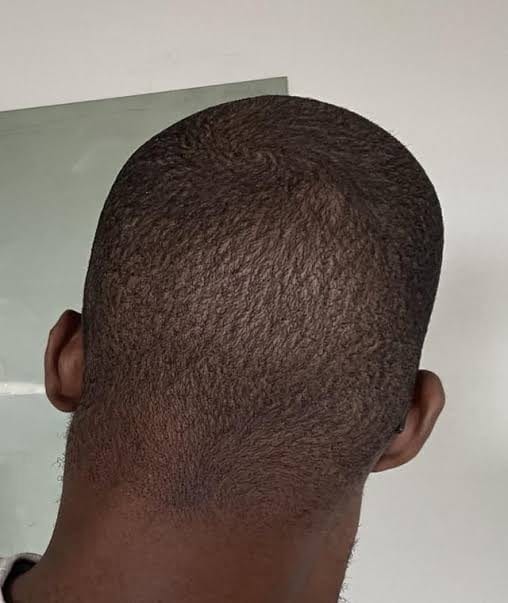
Afro-textured hair as donor: demanding extraction, strong coverage
The follicles in Afro-textured hair curve beneath the skin. That raises the risk of cutting the follicle and calls for a specific way of extracting grafts.
Beneath the skin, the follicles in Afro-textured hair curve, often sharply. That raises the risk of transection and calls for a specific extraction technique. In return, each hair covers a lot, and when hair and skin are close in colour, dot scars show less.
Why is Afro-textured donor hair harder to extract?
Because the follicle curves beneath the skin, often in a direction you can't read from the angle at the surface. If the punch is aligned with the angle you see, it can cut the follicle, and every cut follicle costs both a wound in the donor area and a graft.
In Afro-textured hair the follicle doesn't run in a straight line down into the skin. It curves, often sharply, and its direction rarely matches the angle at which the hair leaves the scalp. If you set a punch by what you see on the surface, you won't necessarily hit the follicle below.
The risk of transection, meaning the follicle is cut through, is therefore higher than in straight hair. Every follicle lost this way leaves a wound in the donor area without giving you a usable graft. That makes high transection a question of how the reserve is managed, not just of skill. It uses up donor hair for nothing.
The answer is a specific technique. The punch is chosen to suit the curve, the angle is assessed carefully for each follicle, and sometimes a punch with a slightly larger diameter is chosen so the curved part fits. Not least, it takes an operator with a lot of experience with this particular hair type. A clinic that sees Afro-textured hair only occasionally is the wrong place.
What advantages does Afro-textured hair offer in a transplant?
Tight curls cover far more scalp than straight hair of the same thickness, and coarse hairs add to the effect. When hair and skin are both dark, both thinning and dot scars are well hidden, and a moderate number of grafts can look as full as a larger number in others.
It isn't all drawbacks. Afro-textured hair has clear strengths that partly make up for the difficult extraction.
- High coverage per follicle. A tight curl fills far more visible area than a straight hair of the same diameter, so each graft gives more impression of fullness.
- Often strong hairs, which boost the effect further.
- Low contrast. Dark hair against dark skin makes thin areas and dot scars much less visible than dark hair against light skin.
- Extraction is well hidden in the donor area for the same reasons.
A small, careful extraction can therefore give a better-looking result than the same number in someone with straight hair. That is a good argument for saying no to pressure for a large session.
What do you need to know about scarring when your donor hair is Afro-textured?
Some people with dark skin form keloids and hypertrophic scars more easily, and such scars can occur after FUE. If you or your family have keloids, it must come up in the consultation, and it may be a reason not to proceed, while light dots can show more against dark skin when the hair is cropped close.
There are two things you should raise.
The first is keloids and hypertrophic, meaning thickened, scars. Some people with dark skin are more prone to such scars, and they are a known complication after FUE. If you or anyone in your family has had keloids, the surgeon must know. The risk changes for both FUE and FUT (strip method), and sometimes the right answer is not to go ahead.
The second is pigment. Dot scars often lose their colour, and against dark skin light dots can show more when the hair is clipped very short, even though the contrast is otherwise favourable. The question is the same as for everyone else: how short do you want to wear your hair?
What does traction alopecia mean for the donor assessment?
Traction alopecia comes from tight braids, weaves, locs or extensions pulling on the hair over a long time, and it is usually not driven by androgens. The donor area is therefore often completely healthy, but the pulling must have stopped and the condition must have settled, and with scarring the disease must have been quiet for a long time, often one to two years.
Traction alopecia, where tight braids, weaves, locs or extensions have pulled on the hair over time, is a common reason people with Afro-textured hair seek treatment. For the donor discussion it is in many ways good news.
The condition is usually not caused by androgens. The back of the head is therefore usually not affected, and the whole reserve remains. That makes you a better candidate than someone with hereditary hair loss that looks just as extensive.
Two things must be in place. The pulling must have stopped, and the area must have been stable for a good while before the procedure. If grafts are placed while the hairstyle is still pulling on the skin, the damage is repeated. If scarring has occurred, the disease must have been quiet for a long time, often one to two years, before a transplant is considered.
What should you ask when choosing a clinic for Afro-textured hair?
Ask how many people with your hair type the surgeon has operated on, and ask for photos of the donor area twelve months afterwards. Ask about the transection rate for this hair type and which punch and technique are used on curved follicles, raise keloids directly, and find out who extracts the grafts throughout the session.
- How many people with your hair type has the surgeon operated on? Ask for photos of the donor area twelve months afterwards.
- What is their transection rate in this hair type, and how is it measured?
- Which punch size and which technique do they use when the follicles curve?
- Tell them about keloids or thickened scars, both your own and in your family.
- Is it the surgeon who extracts the grafts, and who does it for the rest of the session?
General experience is no substitute for experience with this hair type. You see the difference in the donor area, rarely in the hairline photos.
Sources
- Romera de Blas C, Vega Díez D, Ricart Vayá JM, Gómez Zubiaur A. Complications in follicular unit excision hair transplantation: current evidence and practical approaches. Frontiers in Medicine, 2026;13:1750989. pubmed.ncbi.nlm.nih.gov/41709896
- Kim J, Ko YU, Yi KH. The condition of hair follicles produced by different punching methods during FUE surgery. Journal of Cosmetic Dermatology, 2024;23(12):4202-4207. pubmed.ncbi.nlm.nih.gov/39152658
- Chauhan K, Tandon M, Kumar A, Taneja N, Hamid SAT. A comprehensive review of evolution of advanced follicular unit excision systems. Journal of Cutaneous and Aesthetic Surgery, 2025;18(2):69-77. pubmed.ncbi.nlm.nih.gov/40212421
- Rassman WR, Bernstein RM, McClellan R, Jones R, Worton E, Uyttendaele H. Follicular unit extraction: minimally invasive surgery for hair transplantation. Dermatologic Surgery, 2002;28(8):720-728. pubmed.ncbi.nlm.nih.gov/12174065
- Jimenez F, Ruifernández JM. Distribution of human hair in follicular units. A mathematical model for estimating the donor size in follicular unit transplantation. Dermatologic Surgery, 1999;25(4):294-298. pubmed.ncbi.nlm.nih.gov/10417585
This article is based on published research and standard clinical practice. It is general information, not medical advice, and it never takes priority over what your own surgical team tells you. If they say something different from what you read here, follow their advice.
Wondering what's possible for your hair?
Send three sharp photos of your hair, from the front, the top and the back. You'll get an honest answer on what can be done, roughly how many grafts it would take and what it costs.
- Free and with no obligation
- Photos are assessed by the clinic's medical team
- Replies usually within an hour in the daytime


A study tells you something about groups. Only a doctor who has seen your photos can say what applies to your hair. The medical team at the clinic at the top of our ranking offers a free assessment.
Goes to the clinic at the top of our ranking.