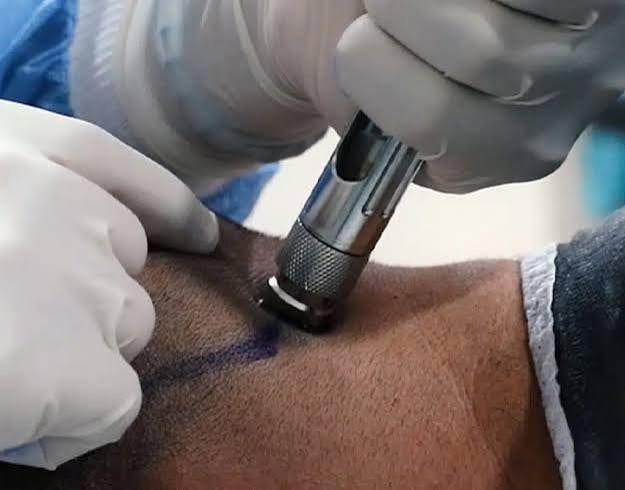
Is FUE done under local or general anaesthesia?
FUE is done under local anaesthetic, and the injections at the start are the worst part of the day for most people.
FUE is done under local anaesthetic, and the injections at the start are the worst part of the day for most people. Some clinics also offer sedation. General anaesthesia is not part of a standard procedure, and you should question a clinic that uses it routinely.
How does local anaesthetic work during FUE?
The anaesthetic is injected around the donor area first and around the recipient area later. It creates a numb ring that lasts several hours and is topped up during the procedure, usually with added adrenaline to reduce bleeding. Once it has taken effect, most people only feel pressure and a sense that something is happening, not pain, and you can talk, eat and use your phone throughout the procedure.
How do clinics make the injections less uncomfortable?
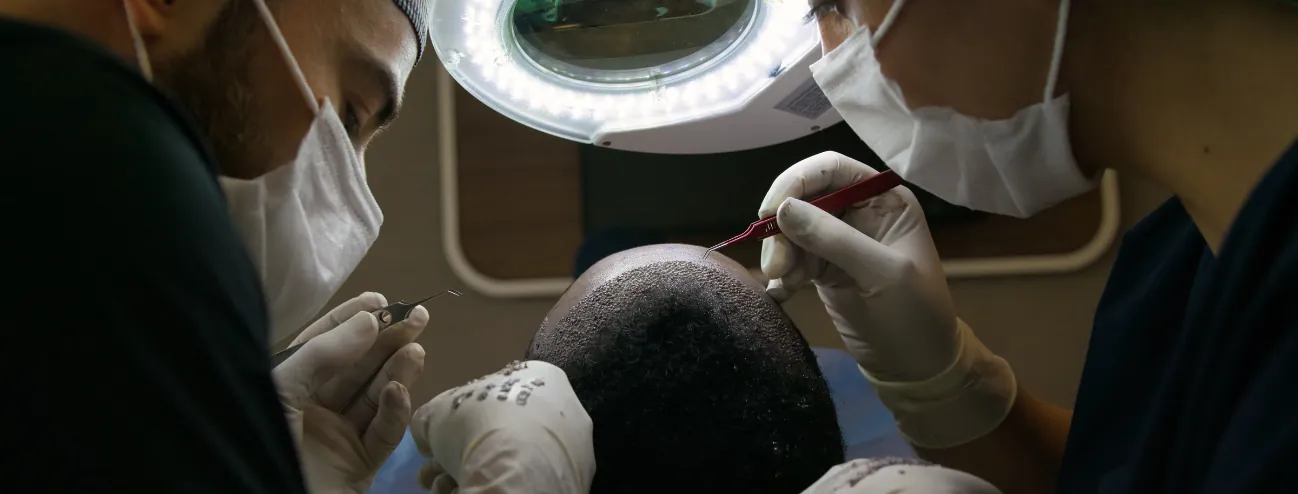
Clinics use vibration or cold against the skin at the moment of injection, very fine needles, slow rather than fast injection, and buffered anaesthetic that stings less. Some also give a mild sedative beforehand. The phase is over within minutes, but clinics differ in how much they do to ease it.
- A vibrating device or cold against the skin while the needle goes in
- Extra-fine needles
- Slow injection, which hurts less than fast
- Buffered anaesthetic, so it stings less
- In some cases a mild sedative before starting
This part is over in minutes, not hours. Even so, clinics differ a lot in how much effort they put into it, so it's worth asking.
What do you need to know about sedation?
Some clinics give anxious patients sedatives, either as a tablet or directly into a vein. That raises the requirements for monitoring: there must be enough staff, the right equipment and someone qualified to handle the drugs. If you're offered this, ask who gives it, who monitors you and what qualifications they have.
Do you get general anaesthesia for a hair transplant?
No, not as standard. The procedure doesn't need general anaesthesia, and general anaesthesia carries a risk that is out of proportion for a cosmetic procedure easily done under local anaesthetic. If a clinic suggests general anaesthesia for an entirely routine procedure, ask why and expect a specific answer.
Anaesthesia is a natural thing to ask about, alongside the questions we suggest in our guide on how to choose a clinic.
Sources
- Nusbaum BP. Techniques to reduce pain associated with hair transplantation: optimizing anesthesia and analgesia. American Journal of Clinical Dermatology, 2004;5(1):9-15. pubmed.ncbi.nlm.nih.gov/14979739
- Barusco MN. Anesthesia Techniques for Harvesting via Follicular Unit Excision. Facial Plastic Surgery, 2024;40(2):175-179. pubmed.ncbi.nlm.nih.gov/38049107
- Patwardhan N, Mysore V; IADVL Dermatosurgery Task Force. Hair transplantation: standard guidelines of care. Indian Journal of Dermatology, Venereology and Leprology, 2008;74 Suppl:S46-S53. pubmed.ncbi.nlm.nih.gov/18688103
This page summarises published studies and common clinical practice. It is general information, not medical advice, and it doesn't replace the instructions from the team that operates on you. If they tell you something different from what you read here, follow their advice.
Wondering what's possible for your hair?
Send three sharp photos of your hair, from the front, the top and the back. You'll get an honest answer on what can be done, roughly how many grafts it would take and what it costs.
- Free and with no obligation
- Photos are assessed by the clinic's medical team
- Replies usually within an hour in the daytime


A study tells you something about groups. Only a doctor who has seen your photos can say what applies to your hair. The medical team at the clinic at the top of our ranking offers a free assessment.
Goes to the clinic at the top of our ranking.