
How to sleep after a hair transplant: first week and side sleeping
Flat on your back with your head raised. That is the position that does the least harm in the first week.
Flat on your back with your head raised is the position that does the least harm in the first week. The grafts are spared pressure while they can still come loose, and gravity draws fluid away from your forehead. Swelling there peaks at around days two to four.
Why is sleeping on your back with your head raised the best position?
Because one position solves two problems. On your back, the transplanted area stays clear of the pillow, and grafts that haven't anchored yet are spared pressure and friction. With your head raised, fluid from the procedure drains down towards your neck instead of collecting in your forehead and around your eyes overnight. People who sleep flat therefore often wake up more swollen.
How should you set up your bed?
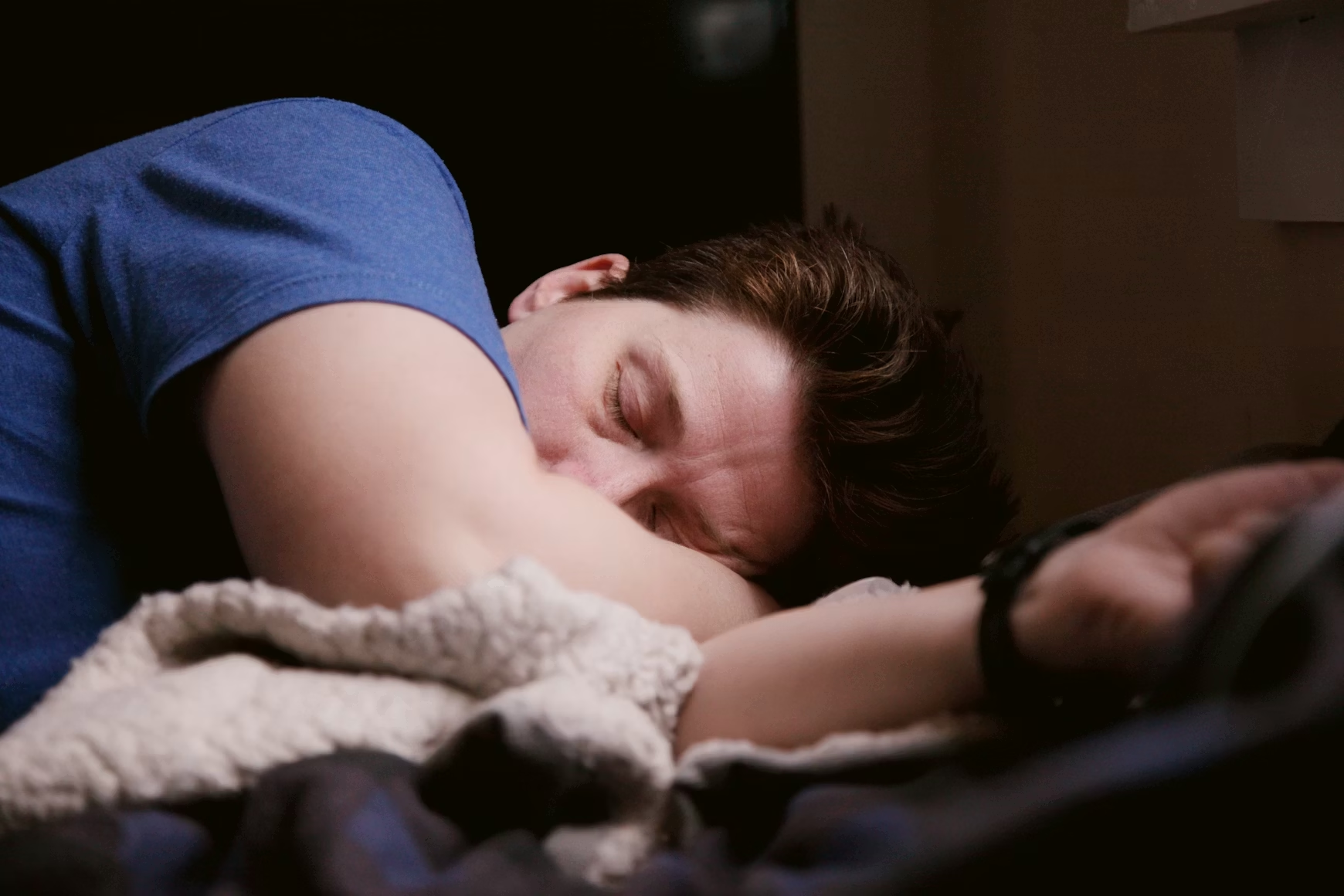
Raise your upper body slightly, to about 20 to 30 degrees, with a few extra pillows, a wedge pillow or a recliner. A neck pillow keeps your scalp from resting against anything. Choose a smooth pillowcase that you change often, and put a dark towel over the pillow, because a little oozing in the first few nights is completely normal.
- Extra pillows, a wedge pillow or a recliner, with your upper body slightly raised, around 20 to 30 degrees
- A neck pillow that supports your head so the back of it stays free
- A smooth, clean pillowcase, changed often
- A dark towel over the pillow for the first few nights, because a little oozing is common
Which positions should you avoid?
Sleeping on your front, because your face and hairline rub against the pillow. Lying completely flat on your back, because fluid then collects more easily in your forehead, although the research is mixed here. Any position where transplanted skin rests on the surface. And a recliner without neck support, which just gives you a sore neck instead.
- Sleeping on your front, which rubs against the transplanted area
- Lying completely flat on your back, which can cause more swelling for some people
- Positions where the grafts rest against the pillow
- A recliner without neck support, which gives you a stiff neck
Which sleeping position do clinics recommend night by night, and when can you sleep on your side?
For the first five nights, sleep on your back with your head raised. Your back is still the first choice up to night nine, but some clinics allow side sleeping when the pillow doesn't touch any transplanted area. Around day nine or ten, most people can sleep however they like, and sleeping on your front is the last position to be allowed.
- Nights 1 to 5: on your back with your head raised. This also keeps swelling down.
- Nights 5 to 9: preferably still on your back. Some clinics accept side sleeping when the pillow doesn't touch any grafts.
- From about day 9 to 10: your choice, side included, at most clinics.
- On your front: allowed last, because your forehead and hairline rub against the pillow most easily.
Why are the sleeping rules so strict, and does the timeline apply to everyone?
To prevent pressure and friction on grafts that haven't anchored yet. In the graft anchoring study, a tug on the hair could pull out a graft in the first two days, and a scab could take a graft with it up to day five. The timeline doesn't apply to everyone in the same way, because grafts at the temples and above the ears end up against the pillow when you lie on your side.
The sleeping rules are there to prevent pressure and friction on grafts that haven't anchored yet. In Bernstein and Rassman's anchoring study, a tug on the hair could pull out a graft in the first two days. A scab that was stuck could still take a graft with it right up to day five, while from day nine the grafts held firm. The study is small and a few years old, but it is the best numerical basis the field has, and clinics' timelines for sleep, hats and washing are largely based on it. At night you don't notice how you turn, and that's exactly where the risk is hardest to control.
Nor is the timeline the same for everyone. If only your hairline has been filled in, no grafts touch the pillow when you turn on your side. If you've had a lot placed at the temples or above the ears, those are exactly the areas that end up against the pillowcase. Treat the general plan as a minimum, and ask your clinic for an answer that fits your own graft map.
What should you do if you sleep badly this week?
Expect a few restless nights. Sleeping half sitting up feels strange, the donor area may ache, and the itching often starts towards the end of the week. Ask your clinic before taking sleeping pills, because they can interact with the medicines you were sent home with. Alcohol worsens sleep and increases swelling, so it is no solution.
More tips for the first few days are in our aftercare guide.
Sources
- Bernstein RM, Rassman WR. Graft Anchoring in Hair Transplantation. Dermatologic Surgery, 2006;32(2):198-204. pubmed.ncbi.nlm.nih.gov/16442039
- Romera de Blas C, Vega Díez D, Ricart Vayá JM, Gómez Zubiaur A. Complications in follicular unit excision hair transplantation: current evidence and practical approaches. Frontiers in Medicine, 2026;13:1750989. pubmed.ncbi.nlm.nih.gov/41709896
- Garg AK, Garg S. Complications of Hair Transplant Procedures-Causes and Management. Indian Journal of Plastic Surgery, 2021;54(4):477-482. pubmed.ncbi.nlm.nih.gov/34984088
This article summarises published studies and standard clinical practice. It is general information, not medical advice. Instructions from your own surgical team always come first, including where they differ from what you read here.
Wondering what's possible for your hair?
Send three sharp photos of your hair, from the front, the top and the back. You'll get an honest answer on what can be done, roughly how many grafts it would take and what it costs.
- Free and with no obligation
- Photos are assessed by the clinic's medical team
- Replies usually within an hour in the daytime


A study tells you something about groups. Only a doctor who has seen your photos can say what applies to your hair. The medical team at the clinic at the top of our ranking offers a free assessment.
Goes to the clinic at the top of our ranking.