How long does swelling last after a hair transplant?
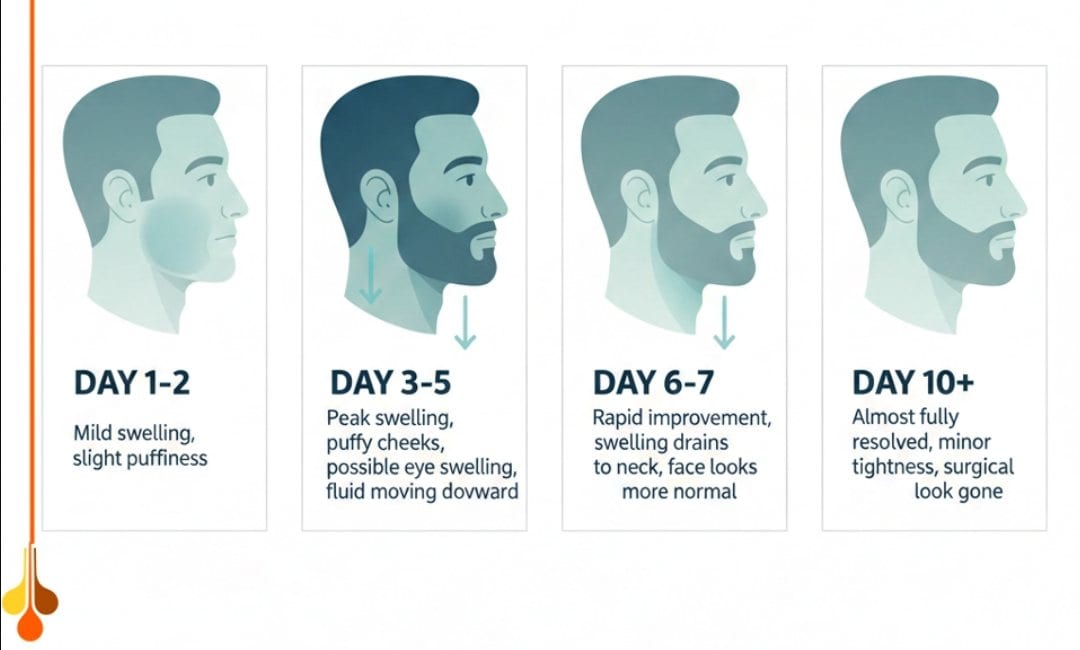
Swelling usually appears on days two to four, peaks for a day or two and has eased after about a week. Gravity moves it from the scalp down to the forehead and sometimes the eyelids, so it rarely stays where you were operated on.
Anaesthetic fluid and the tissue's reaction to the procedure are the cause. Gravity pulls the fluid down from the scalp, so it's the forehead and sometimes the eyelids that puff up. Swelling usually appears on days two to four, peaks for a day or two and then eases. It can look dramatic but is almost always harmless. Swelling that shows up late or sits on one side is a different matter.
Why does the forehead swell and not the scalp?
During the procedure, a lot of anaesthetic and saline is injected into the scalp, and the inflammation around all the small wounds draws in more. The scalp sits tight over the skull and has little room. So the fluid drains down to the loose tissue above the eyes and in the forehead.
During a hair transplant the scalp takes on a lot of fluid. First local anaesthetic, and usually also saline that firms up the tissue before the grafts are placed. At the same time the body responds to all the wounds with inflammation, which draws even more fluid into the area.
All that fluid has to go somewhere. The scalp is stretched tight over the skull and has little room. The forehead and the skin around the eyes are looser and give way. Gravity pulls the fluid down through the soft tissue, which is why you swell up in places nobody operated on.
For the same reason, you swell more if you lie flat in the days afterwards.
How does the swelling develop day by day?
The pattern is fairly predictable. On days zero and one there's little or nothing to see. From days two to four the swelling arrives and is worst over the forehead and eyelids. From days four to seven it gradually recedes. At its peak, one eye can be half closed for a day. It looks alarming but is not a complication.
| Days after the procedure | What you usually see |
|---|---|
| 0 to 1 | Little or nothing. Many feel fine and think they've got off lightly. |
| 2 to 4 | The swelling arrives and peaks, often across the whole forehead and sometimes down into the eyelids. |
| 4 to 7 | It slowly recedes as the body absorbs and clears the fluid. |
At worst, one or both eyes can be half closed for a day. It's unpleasant to look at, but it doesn't in itself mean anything is wrong.
What helps reduce the swelling?
Whatever works with gravity. Most important is sleeping with your head raised for the first nights. Stay upright during the day, and put cold only on your forehead. The grafts should not get ice. Some clinics prescribe a short course of steroids, which you take exactly as prescribed. Avoid massage, hard exercise, alcohol and ice on the recipient area.
What works is whatever uses gravity rather than fighting it.
- Head raised at night. Use several pillows or sleep half sitting up, or in a recliner. Three to five nights is usually enough. No other single thing does more.
- Stay upright during the day. Sit and walk rather than lie down.
- Cold on the forehead, not on the grafts. Put a cold compress over your forehead and brows, never on the recipient area.
- Follow the prescription. Some clinics give a short steroid course to keep swelling down. Take it as your doctor has decided, and don't adjust it yourself.
- Drink plenty and eat little salt in the days right after the procedure.
What to avoid: massage, hard exercise and alcohol. Rubbing the swelling won't get rid of it and can damage the grafts. Heavy exercise pushes up blood pressure and makes swelling worse in week one, and alcohol widens the blood vessels and should wait until the swelling has gone. The most common mistake is ice directly on the recipient area. Ice presses on the grafts and wets them in the days when they can still come loose. More on how to lie is in the aftercare guide.
When is swelling a warning sign?
Normal swelling is the same on both sides, hurts little or not at all and is going down by the end of the first week. Tell your clinic if it's only on one side, feels warm, tender and red, comes late or gets worse again, or comes with a fever. If you struggle to swallow or breathe, call 113 (the Norwegian emergency number), not the hair clinic.
Ordinary swelling after the procedure is the same on both sides, hurts little or not at all and is clearly better once the first week is over. If yours looks different from this, get in touch:
- Clear swelling on one side only
- The swelling is red, warm and painful to touch, not soft and pale
- It comes late, after the first week, or picks up again after it had started going down
- You have a fever at the same time
- You struggle to swallow or breathe. Then you need emergency help, and the hair clinic is the wrong place to call
Sources
- Romera de Blas C, Vega Díez D, Ricart Vayá JM, Gómez Zubiaur A. Complications in follicular unit excision hair transplantation: current evidence and practical approaches. Frontiers in Medicine, 2026;13:1750989. pubmed.ncbi.nlm.nih.gov/41709896
- Kerure AS, Patwardhan N. Complications in Hair Transplantation. Journal of Cutaneous and Aesthetic Surgery, 2018;11(4):182-189. pubmed.ncbi.nlm.nih.gov/30886471
- Garg AK, Garg S. Complications of Hair Transplant Procedures-Causes and Management. Indian Journal of Plastic Surgery, 2021;54(4):477-482. pubmed.ncbi.nlm.nih.gov/34984088
- Sun Y, Xu F, Zhang J, Fan Z, Qu Q, Liu Y, et al. Comprehensive Prevention for Edema after Hair Transplantation: A Multicenter Study of 1167 Patients. Plastic and Reconstructive Surgery, 2026;157(1):49e-57e. pubmed.ncbi.nlm.nih.gov/40663782
- Bernstein RM, Rassman WR. Graft Anchoring in Hair Transplantation. Dermatologic Surgery, 2006;32(2):198-204. pubmed.ncbi.nlm.nih.gov/16442039
This text brings together findings from published research and standard clinical practice. It is general information and not medical advice. The instructions from the team that operated on you come first. If they tell you something different from what is written here, follow their advice.
Wondering what's possible for your hair?
Send three sharp photos of your hair, from the front, the top and the back. You'll get an honest answer on what can be done, roughly how many grafts it would take and what it costs.
- Free and with no obligation
- Photos are assessed by the clinic's medical team
- Replies usually within an hour in the daytime


A study tells you something about groups. Only a doctor who has seen your photos can say what applies to your hair. The medical team at the clinic at the top of our ranking offers a free assessment.
Goes to the clinic at the top of our ranking.