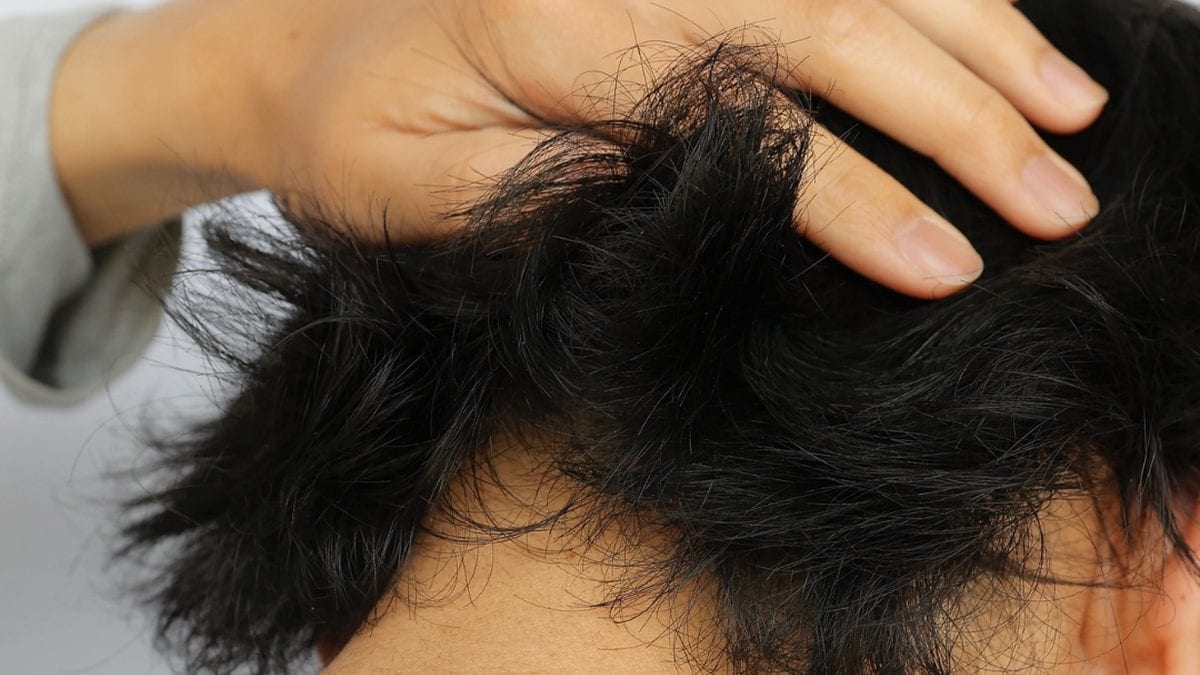
How long does the donor area take to heal after a hair transplant?
First come scabs, after a week to ten days the skin is clear, the redness fades over the following month, and only after six to twelve months is the back of the head finished.
The back of the head is covered in small scabs for the first few days, is clear after a week to ten days, loses its redness over the following month and looks the way it's going to look six months to a year after the procedure. If you judge the donor area before then, you're judging too early.
What happens to the back of the head in the first three days?
Small scabs form over each harvest site, and the skin is pink or red, tender and tight, most of all along the stitch line after FUT. Discomfort is at its peak now and makes sleeping difficult, so keeping your head raised helps with both pain and swelling, and washing begins when your clinic says so.
What happens from day four to day ten?
The scabs soften and come away with regular, gentle washing, and for most people the skin is clear between days seven and ten. The pink tone lingers and often shows more without the scabs, but the tenderness clearly lessens, and the washing schedule matters most now, because scabs that stay on for a long time lead to more folliculitis.
How does the back of the head change from week two to week six?
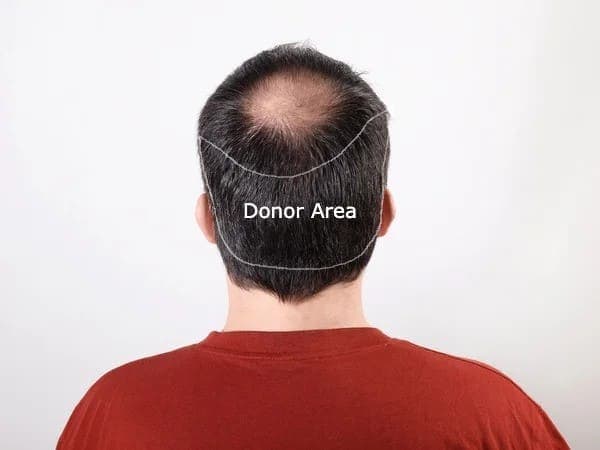
The redness fades, more slowly if you have fair skin, and itching often appears as the nerves wake up. Small spots from hairs pushing through are common and clear up without treatment. Some people also temporarily lose hair around the harvest sites, which looks worrying but grows back within a few months.
The redness gradually fades. If you have fair skin, it usually takes longer, and the pink tone can stay several weeks longer than you expected.
Itching is common during this period. It's linked to the skin healing and the sensory nerves waking up. It can be bothersome, but you mustn't scratch.
Small spots where new hairs are trying to get through the healing skin, known as folliculitis, are common from around week two and usually clear up without treatment.
In some people, native hair around the harvest sites temporarily falls out. This is called shock loss in the donor area. It looks alarming, but it comes back, even though it takes months.
What does the donor area look like after two to four months?
The redness has mostly gone, and the harvest sites have become the small, pale dots they will remain. Hair that fell out at the back starts to come back at roughly the same pace as the transplanted hair, numbness keeps improving, and even though the back of your head may look normal with a bit of length, it isn't finished.
When is the donor area fully healed?
Somewhere between six months and a year, and only then can you judge the result at the back honestly. Density has settled, including after any shedding, the dot scars have reached their final colour against the skin, and any thick scars or pale patches have shown themselves.
Only now has the donor area taken on the appearance it will keep, and only now does it make sense to judge how the harvest went.
- Density has stabilised, including after any temporary shedding.
- The dot scars have reached the contrast with the surrounding skin that they will keep.
- Now you can see whether thick scars or permanent pale patches have formed.
- You can find out how short the hair can be cut before the harvest shows.
So don't conclude that you've been overharvested at three months. Nor should you decide that it all went fine. Both conclusions have to wait until twelve months have passed.
Which photos should you take to track the healing?
Take a photo straight from behind before the procedure, at a hair length you've noted and in the same lighting, and take the same photo again at three months, six months and one year. Also write down the measured density and what proportion was due to be harvested, because memory is not a good source.
- A photo straight from behind before the procedure, at a hair length you know and in the same lighting.
- Exactly the same photo at three months, six months and one year.
- A note of the measured density before the procedure and the proportion planned to be harvested.
It costs nothing, and without such photos you'll never get an objective answer. Memory is unreliable when it comes to the back of your head, a part of you that you almost never see yourself.
What happens at the front during the same weeks is covered under aftercare.
Sources
- Romera de Blas C, Vega Díez D, Ricart Vayá JM, Gómez Zubiaur A. Complications in follicular unit excision hair transplantation: current evidence and practical approaches. Frontiers in Medicine, 2026;13:1750989. pubmed.ncbi.nlm.nih.gov/41709896
- Rassman WR, Bernstein RM, McClellan R, Jones R, Worton E, Uyttendaele H. Follicular unit extraction: minimally invasive surgery for hair transplantation. Dermatologic Surgery, 2002;28(8):720-728. pubmed.ncbi.nlm.nih.gov/12174065
- Bernstein RM, Rassman WR. Graft Anchoring in Hair Transplantation. Dermatologic Surgery, 2006;32(2):198-204. pubmed.ncbi.nlm.nih.gov/16442039
- Giardiello F, De Medeiros Quirino L, Brigante R, Chumak M. Hyperbaric Oxygen Therapy for Enhanced Postoperative Recovery in Hair Transplantation. Cureus, 2025;17(12):e99635. doi.org/10.7759/cureus.99635
- Parsley WM, Perez-Meza D. Review of factors affecting the growth and survival of follicular graft. Journal of Cutaneous and Aesthetic Surgery, 2010;3(2). jcasonline.com
This article is based on published research and standard clinical practice. It is general information, not medical advice, and it never overrides what your own surgical team tells you. If they say something different from what you read here, follow their advice.
Wondering what's possible for your hair?
Send three sharp photos of your hair, from the front, the top and the back. You'll get an honest answer on what can be done, roughly how many grafts it would take and what it costs.
- Free and with no obligation
- Photos are assessed by the clinic's medical team
- Replies usually within an hour in the daytime


A study tells you something about groups. Only a doctor who has seen your photos can say what applies to your hair. The medical team at the clinic at the top of our ranking offers a free assessment.
Goes to the clinic at the top of our ranking.