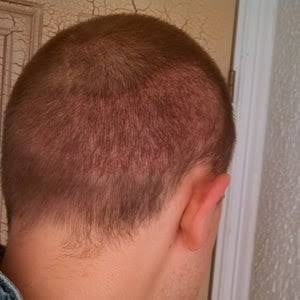
Spots on the back of the head after FUE: folliculitis, ingrown hairs
Many people get small, inflamed spots on the back of the head in the first weeks after harvesting. Usually they're caused by hairs that can't break through the healing skin.
In the weeks after harvesting, it's common to get small, inflamed spots in the donor area. Most often they come from hairs that can't get through the healing skin. Most disappear without you doing anything, but inflammation that persists or spreads should be seen by your clinic.
How do you recognise folliculitis at the back of the head?
You'll see small red dots, some with white pus on top, sitting around individual hairs, and they can be tender. They tend to appear after a couple of weeks and can come and go for several months. It's so common that it's considered normal, alongside known complications such as loss of pigment, thickened scars, skin cysts and a depleted donor area.
Why do people get folliculitis at the back of the head after FUE?
The main cause is new hairs getting trapped under the denser skin over a harvest site, turning back and causing inflammation the way an ingrown beard hair does. Remnants of cut follicles, scabs or thick ointment blocking openings, bacteria getting in when you scratch, and sweat or friction from headwear and exercise also play a part.
- Trapped hairs. The skin covering a harvest site as it heals can be denser than usual. When a new hair can't get through, it curls back under the skin and causes inflammation, just like an ingrown beard hair after shaving.
- Remnants of follicles. If a follicle was cut across during harvesting, the part left behind can go on producing a hair that can't find its way out.
- Scabs and blockage. Scabs left on too long, or thick ointment, can block the openings.
- Bacteria. The skin's normal bacteria can get into disturbed follicles, especially if you scratch.
- Sweat and friction. Beanies and other headwear, and exercise before the back of your head has settled down.
What should you do if you get spots in the donor area?
The most important thing is to leave the spots alone, because squeezing can cause infection and turn a spot that would have cleared up on its own into a scar. Don't dig for ingrown hairs, wash as agreed, use warm compresses if your clinic says yes, and let your clinic know.
Your own clinic's advice comes first. Otherwise, these are the main rules:
- Leave the spots alone. Nothing matters more. If you squeeze a spot while the skin at the back is still healing, you risk infection, and a spot that would have cleared up can become a scar.
- Don't dig for ingrown hairs.
- Wash as planned. Gentle, regular washing helps. Stopping washing because it's sore makes things worse.
- Warm compresses often make a single spot settle down, as long as your clinic agrees.
- Speak up. Clinics see this often and can quickly tell whether it's the usual picture.
When does folliculitis need treatment from a doctor?
It usually clears up within a few days. Get in touch if the spots multiply, if a larger area becomes red, warm or swollen, if there is a lot of pain or a fever, if spots keep returning to the same place, or if there is a firm lump, and treatment is then most often antibiotics and sometimes draining a cyst.
Most often the spots disappear on their own within a few days. Contact your clinic if:
- The spots are increasing in number instead of decreasing.
- Redness, warmth or swelling spreads across an area, not just around individual spots.
- It's very painful.
- You develop a fever.
- They keep coming back in the same place over several weeks. That can be caused by a follicle remnant or a cyst.
- You can feel a firm lump. That may be a skin cyst rather than folliculitis.
If treatment is needed, it's usually simple: antibiotics as a cream or tablets, and occasionally draining a cyst. That should be done by a doctor or the clinic, not by you.
How can you reduce the risk of folliculitis?
Follow the washing schedule from day one, including the deadline for the scabs to have come off, and keep tight beanies and headbands off the back of your head until it has healed. Hold off on sweaty exercise until your clinic says yes, don't shave or cut the back of your head before you've been given the go-ahead, and change your pillowcase often in the first weeks.
- Follow the washing schedule from day one, including the deadline for the scabs to have come off.
- Keep tight beanies and headbands off the back of your head while it heals.
- Don't start sweaty workouts until your clinic says it's fine.
- Don't shave or cut the donor area until you've been given the go-ahead.
- Change your pillowcase often in the first weeks.
Why is folliculitis more serious at the back of the head than at the front?
At the front, folliculitis is a nuisance, but the grafts are rarely harmed. At the back, inflammation and infection around fresh harvest sites can cause worse scarring, and thickened scars are a known complication there. The look of the back of your head is shaped during exactly these weeks, and it can't be repaired afterwards.
You can read about how a donor area normally heals in our aftercare guide.
Sources
- Romera de Blas C, Vega Díez D, Ricart Vayá JM, Gómez Zubiaur A. Complications in follicular unit excision hair transplantation: current evidence and practical approaches. Frontiers in Medicine, 2026;13:1750989. pubmed.ncbi.nlm.nih.gov/41709896
- Giardiello F, De Medeiros Quirino L, Brigante R, Chumak M. Hyperbaric Oxygen Therapy for Enhanced Postoperative Recovery in Hair Transplantation. Cureus, 2025;17(12):e99635. doi.org/10.7759/cureus.99635
- Fan Z, Gan Y, Qu Q, Wang J, Lunan Y, Liu B, Chen R, Hu Z, Miao Y. The effect of hyperbaric oxygen therapy combined with hair transplantation surgery for the treatment of alopecia. Journal of Cosmetic Dermatology, 2021;20(3):917-921. pubmed.ncbi.nlm.nih.gov/32770782
- Rassman WR, Bernstein RM, McClellan R, Jones R, Worton E, Uyttendaele H. Follicular unit extraction: minimally invasive surgery for hair transplantation. Dermatologic Surgery, 2002;28(8):720-728. pubmed.ncbi.nlm.nih.gov/12174065
This article is based on published research and standard clinical practice. It is general information, not medical advice, and it never overrides what your own surgical team tells you. If they say something different from what you read here, follow their advice.
Wondering what's possible for your hair?
Send three sharp photos of your hair, from the front, the top and the back. You'll get an honest answer on what can be done, roughly how many grafts it would take and what it costs.
- Free and with no obligation
- Photos are assessed by the clinic's medical team
- Replies usually within an hour in the daytime


A study tells you something about groups. Only a doctor who has seen your photos can say what applies to your hair. The medical team at the clinic at the top of our ranking offers a free assessment.
Goes to the clinic at the top of our ranking.