Donor area aftercare: washing, sleep and what to avoid
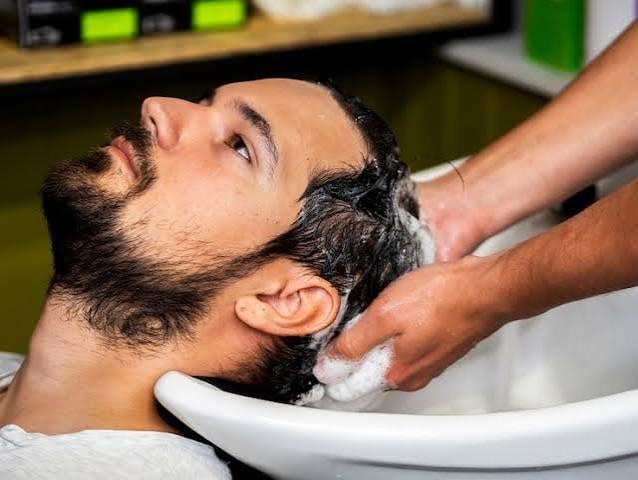
The back of your head should be washed gently and regularly from the day your clinic tells you.
The back of your head should be washed gently and regularly from the day your clinic specifies. The most common mistake is washing too little, which leaves scabs that linger and more folliculitis. Your clinic's own plan always comes before general advice.
Why does the back of the head get less attention than the front?
Because aftercare advice focuses on the grafts at the front, which can fall out early on and are firmly anchored by around day nine. The back of the head has no such deadline. Damage there, however, stays, whereas a hairline can be adjusted.
Almost all the instructions you get after surgery are about the area at the front, and for good reason. In the first few days the grafts can physically fall out, so they need protecting. Research on how grafts anchor has shown the timeline clearly: the grafts are vulnerable right after surgery and have settled in by around day nine.
The back of the head has no such countdown, which is why it's easily forgotten. On the other hand, what happens there is permanent. A hairline that didn't work out can often be adjusted. A back of the head that healed badly stays that way.
How do you wash and care for the donor area?
Follow your clinic's plan. In general, that means starting to wash on the day the clinic specifies, not later, washing gently but thoroughly with the products you were given, using lukewarm water with a gentle stream, patting dry instead of rubbing and not scratching.
Your clinic's own plan takes priority over everything here, including when to do what. Clinics have different routines, and yours knows your procedure.
- Wash from the day the clinic says. The most common mistake is being overcautious. Scabs left in place raise the risk of folliculitis and mean the back of your head takes longer to settle.
- Gently but thoroughly. The scabs need to come off. Calm, repeated washing loosens them. Careful dabbing with your fingertips doesn't.
- Use what you were given, and don't switch to your own products.
- Lukewarm water and a gentle stream. Hot water and a hard shower jet aren't needed.
- Pat the skin dry. Never rub.
- Don't scratch. Itching in weeks two to six is common. Even so, the back of your head should be allowed to heal without fingernails.
What should you avoid while the back of your head heals?
Tight hats that press on the back of the head early on, sweaty exercise before the clinic says yes, and swimming, saunas and hot tubs before the clinic gives the go-ahead. Also avoid direct sun, because reduced sensation can hide sunburn, hold off on cutting or shaving, and don't pick at anything.
Follow your clinic's timeline here too. These are the main groups:
- Hats and headwear that press on the back of the head in the first few days. Choose something loose, and let the clinic decide when.
- Exercise that makes you sweat is resumed according to the clinic's plan. Sweat and friction contribute to folliculitis.
- Swimming, saunas, steam rooms and hot tubs wait until the clinic gives the go-ahead.
- Direct sun on the skin while it heals. After extraction, sensation is often reduced, so sunburn can creep up on you without you feeling anything.
- Cutting or shaving at the back before the clinic has said it's fine.
- Any picking. Scabs, spots and ingrown hairs should be left alone.
How should you sleep to protect the donor area?
Sleep with your head raised for the first few nights to reduce swelling and tenderness, and lie on your back as far as you can. A neck pillow can help keep pressure off the back of your head, and your pillowcase should be clean and changed often in the first few weeks.
Lying with your weight on the back of your head hurts and isn't good for skin that's healing. For the first few nights:
- Keep your head raised. It reduces both swelling and tenderness.
- Lie on your back as much as you can.
- For some people, a travel-style neck pillow helps keep pressure off the back of the head.
- Use a clean pillowcase, and change it often in the first few weeks.
When should you contact the clinic about the back of your head?
If pain increases after the third day, if red, warm or swollen skin spreads, or if there's discharge or a fever. Also get in touch if the scabs won't come off long after the deadline, if you feel a hard lump, or if spots keep coming back in the same place.
- Pain gets worse after the first three days instead of easing.
- The skin becomes red, warm or swollen over a larger area, or something is oozing.
- Fever.
- Scabs that refuse to come off long after the deadline the clinic gave.
- A firm lump growing at the back.
- Spots that keep coming back in the same place, week after week.
Clinics get these enquiries all the time, and most would much rather receive one message too many than find out about something too late.
How do you document the back of your head while it heals?
Take a photo straight from behind with the same hair length and the same lighting before surgery, and take new ones after three months, six months and a full year. It takes a minute each time, and the photos are the only objective record of an area you never see yourself, so any later conversation with the clinic is based on images, not memory.
This is part of the general washing and care routine we go through under aftercare.
Sources
- Bernstein RM, Rassman WR. Graft Anchoring in Hair Transplantation. Dermatologic Surgery, 2006;32(2):198-204. pubmed.ncbi.nlm.nih.gov/16442039
- Romera de Blas C, Vega Díez D, Ricart Vayá JM, Gómez Zubiaur A. Complications in follicular unit excision hair transplantation: current evidence and practical approaches. Frontiers in Medicine, 2026;13:1750989. pubmed.ncbi.nlm.nih.gov/41709896
- Giardiello F, De Medeiros Quirino L, Brigante R, Chumak M. Hyperbaric Oxygen Therapy for Enhanced Postoperative Recovery in Hair Transplantation. Cureus, 2025;17(12):e99635. doi.org/10.7759/cureus.99635
- Parsley WM, Perez-Meza D. Review of factors affecting the growth and survival of follicular graft. Journal of Cutaneous and Aesthetic Surgery, 2010;3(2). jcasonline.com
- Fan Z, Gan Y, Qu Q, Wang J, Lunan Y, Liu B, Chen R, Hu Z, Miao Y. The effect of hyperbaric oxygen therapy combined with hair transplantation surgery for the treatment of alopecia. Journal of Cosmetic Dermatology, 2021;20(3):917-921. pubmed.ncbi.nlm.nih.gov/32770782
This article is based on published research and standard clinical practice. It is general information, not medical advice, and it never overrides what your own surgical team tells you. If they say something different from what is written here, their advice is the one to follow.
Wondering what's possible for your hair?
Send three sharp photos of your hair, from the front, the top and the back. You'll get an honest answer on what can be done, roughly how many grafts it would take and what it costs.
- Free and with no obligation
- Photos are assessed by the clinic's medical team
- Replies usually within an hour in the daytime


A study tells you something about groups. Only a doctor who has seen your photos can say what applies to your hair. The medical team at the clinic at the top of our ranking offers a free assessment.
Goes to the clinic at the top of our ranking.