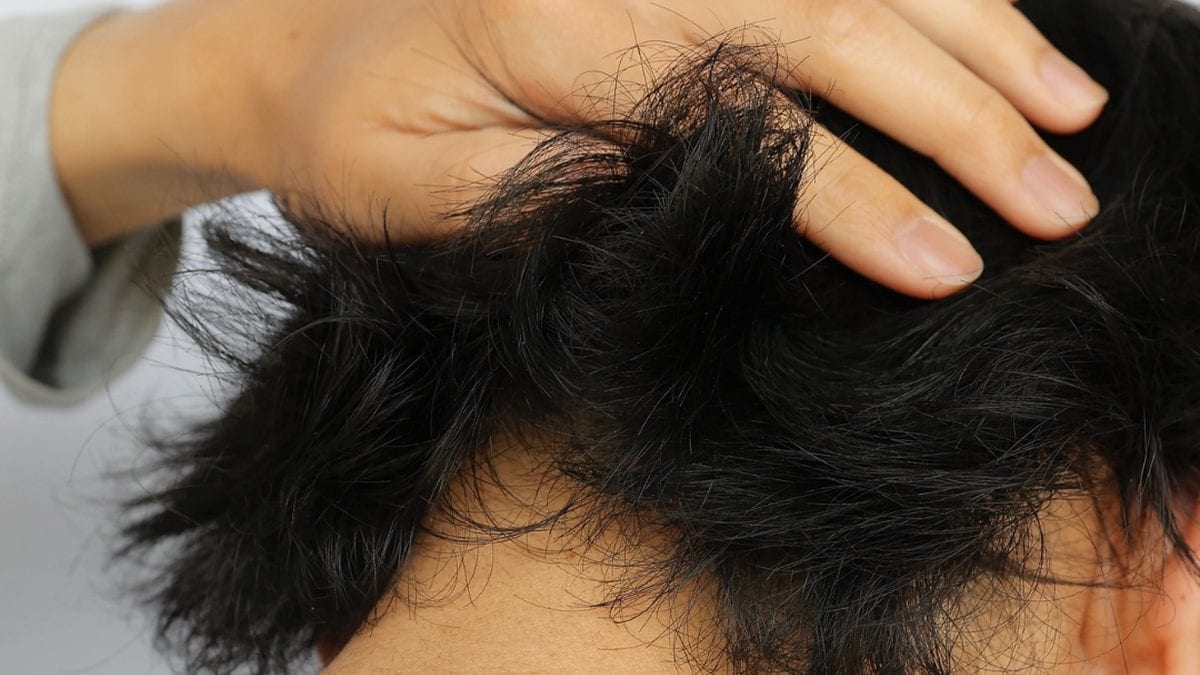
Numb back of the head after a hair transplant: what's normal?
After both FUE and FUT, most people notice reduced feeling in the donor area for a while. It usually comes back within weeks or months.
Most people have reduced feeling at the back of the head after FUE as well as after FUT, and in almost everyone it comes back within a few weeks or months. After FUT the numbness is greater and lasts longer, because one long incision cuts across more of the small nerves in the skin.
Why does the back of the head go numb after a hair transplant?
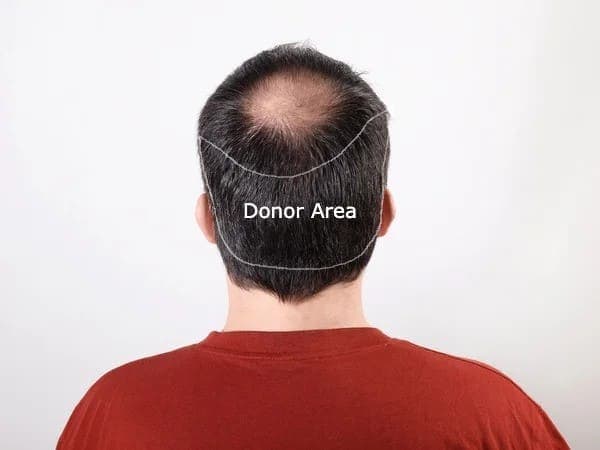
Because the procedure disrupts small sensory nerves running just under the skin. A continuous incision in FUT causes larger and longer-lasting numbness, while the small, scattered punch holes in FUE cause patchy, milder loss of feeling, and the anaesthetic also numbs the skin on the day of surgery itself.
Just under the skin of the scalp lies a network of small sensory nerves. Any procedure in the donor area damages some of them.
In strip surgery, a long horizontal incision runs right across the nerve pathways. The skin above the incision loses feeling until the nerves have grown back together. Numbness after FUT is therefore usually greater and lasts longer.
In FUE, many small, separate holes are made. The nerve damage is spread out and usually milder. Numbness still occurs, often as patches of reduced or altered feeling across the harvested area.
The local anaesthetic and the fluid injected to make harvesting easier (tumescence) also make the skin numb on the day of surgery. That's expected and has nothing to do with nerve damage.
What does the numbness feel like?
Touch can feel muffled or far away, and the skin can feel tight or heavy, in patches after FUE or as a band above the scar after FUT. Along the way, tingling, pins and needles, itching and brief twinges are common, usually signs that the nerves are recovering.
- Reduced sensation: touch feels as if it's coming through a layer.
- Islands of numbness with normal feeling around them, common after FUE.
- A band without full feeling above the scar, common after FUT.
- Tingling and pins and needles, most often a sign that the nerves are waking up.
- Tight or heavy skin, and firm pressure is often felt while a light stroke isn't.
- Itching, often intense, while the nerves regrow.
- Brief, stabbing twinges now and then, as nerve fibres reconnect.
How long does it take for feeling to come back?
The anaesthetic wears off on day 1, numbness is most noticeable in weeks 1 to 4, and feeling gradually returns in months 1 to 3, by which point most of it has resolved after FUE. After FUT most of it disappears between months 3 and 12, and a small proportion have permanently reduced feeling after 12 months, most often after strip surgery.
- Day 1. The anaesthetic wears off within a few hours, and the numbness from the procedure itself becomes noticeable.
- Weeks 1 to 4. The numbness is at its most noticeable. After FUT the back of the head often feels tight during the same period.
- Months 1 to 3. Feeling slowly returns, often accompanied by tingling and itching. After FUE most of the numbness has gone by now.
- Months 3 to 12. Improvement continues. Most of the numbness after FUT disappears during this period.
- After 12 months. A small minority still have an area of permanently reduced feeling, more often after strip surgery.
The timeline shows common patterns, not a promise. The pace differs from one patient to the next.
When is numbness a sign that something is wrong?
If you're only numb, that's normal and needs no treatment. Call your clinic if the pain keeps getting worse, if the skin is red, swollen or warm or fluid is seeping, if the numb area grows or spreads when it should be shrinking, if feeling came back and then went again, if nothing has improved after six months, or if severe pain lingers.
If numbness is the only thing you notice, everything is as expected and nothing needs to be done.
Contact your clinic if you experience any of the following:
- The pain gets worse instead of better.
- The skin becomes red, swollen and warm, or fluid is seeping out, which can mean infection.
- The numb area gets bigger when it should be getting smaller, or spreads beyond the area that was operated on.
- Feeling had started to come back but is fading again.
- Nothing has improved after six months.
- Severe pain that persists. Pain and numbness are two different things, and pain needs to be checked.
Long-lasting nerve pain in the donor area is rare, but it has been described, and it should be checked rather than waiting to see.
How do you look after a numb donor area while it heals?
Be careful with heat from hairdryers, hot water and sun, because the skin can be damaged without you noticing. Don't scratch, even when it itches, expect feeling to return unevenly, and follow your clinic's washing schedule rather than going by how it feels.
- Watch out for heat. Less feeling means less warning. Hairdryers, hot shower water and sun can damage the skin without you noticing.
- Don't scratch. Itching is common while the nerves regrow, but the back of your head needs to heal in peace.
- Expect uneven improvement. Feeling rarely comes back evenly across the whole area.
- Follow the washing schedule from your clinic, not what you can or can't feel.
What should you ask the surgeon about numbness before the procedure?
Find out how numb you're likely to be with the technique you're being offered, and for how long. Also ask how many of the surgeon's patients are still numb after twelve months, what changes if FUT is proposed, and who to call if the feeling doesn't return.
- How much numbness can I expect with this technique, and how long will it last?
- How many of your patients are still numb after twelve months?
- If you recommend FUT, how does that change the answer?
- Who do I call if the feeling doesn't come back?
Sources
- Romera de Blas C, Vega Díez D, Ricart Vayá JM, Gómez Zubiaur A. Complications in follicular unit excision hair transplantation: current evidence and practical approaches. Frontiers in Medicine, 2026;13:1750989. pubmed.ncbi.nlm.nih.gov/41709896
- Rassman WR, Bernstein RM, McClellan R, Jones R, Worton E, Uyttendaele H. Follicular unit extraction: minimally invasive surgery for hair transplantation. Dermatologic Surgery, 2002;28(8):720-728. pubmed.ncbi.nlm.nih.gov/12174065
- Chauhan K, Tandon M, Kumar A, Taneja N, Hamid SAT. A comprehensive review of evolution of advanced follicular unit excision systems. Journal of Cutaneous and Aesthetic Surgery, 2025;18(2):69-77. pubmed.ncbi.nlm.nih.gov/40212421
- Parsley WM, Perez-Meza D. Review of factors affecting the growth and survival of follicular graft. Journal of Cutaneous and Aesthetic Surgery, 2010;3(2). jcasonline.com
- Liu RH, Xu LJ, McCarty JC, Xiao R, Chen JX, Lee LN. A Scoping Review on Complications in Modern Hair Transplantation: More than Just Splitting Hairs. Aesthetic Plastic Surgery, 2025;49(3):585-595. pubmed.ncbi.nlm.nih.gov/39179656
- Kerure AS, Patwardhan N. Complications in Hair Transplantation. Journal of Cutaneous and Aesthetic Surgery, 2018;11(4):182-189. pubmed.ncbi.nlm.nih.gov/30886471
This article is based on published research and standard clinical practice. It is general information, not medical advice, and it never overrides what your own surgical team tells you. If they say something different from what you read here, follow their advice.
Wondering what's possible for your hair?
Send three sharp photos of your hair, from the front, the top and the back. You'll get an honest answer on what can be done, roughly how many grafts it would take and what it costs.
- Free and with no obligation
- Photos are assessed by the clinic's medical team
- Replies usually within an hour in the daytime


A study tells you something about groups. Only a doctor who has seen your photos can say what applies to your hair. The medical team at the clinic at the top of our ranking offers a free assessment.
Goes to the clinic at the top of our ranking.