How does scalp laxity affect your FUT graft yield?
How much your scalp gives decides how wide a strip the surgeon can remove and still close without tension.
Scalp laxity sets the limit for how wide a strip can be removed and closed without tension. A tight scalp gives fewer grafts with FUT and a higher risk of a scar that stretches. For FUE it hardly matters.
What is scalp laxity, and why does it matter in strip surgery?
It is how easily the scalp can be moved over the skull. Some people have a soft scalp that glides well, others a tight one that barely shifts, and with FUT this decides how wide a strip can be removed and still be closed without tension.
Why is wound tension the biggest risk in strip surgery?
Because a wound stitched under tension often stretches as it heals. Instead of a fine line, the scar can end up several millimetres wide, which can't be undone, so if the scalp is tight, a narrower strip and fewer grafts is the wisest choice.
If the strip wound is stitched under tension, the edges pull in opposite directions throughout healing. Where you hoped for a fine line, you get a wider band, often several millimetres and sometimes even more.
A stretched scar is the most important cosmetic complication of FUT (strip method), and in practice it can't be reversed. It can be improved somewhat with scar revision, and it can be hidden with micropigmentation or grafts planted into the scar. It will never be a fine line again.
Faced with a tight scalp, the surgeon therefore has to choose. She can take a narrower strip and accept fewer grafts, or take the width she wants and risk the scar. The first choice is the right one. If you push for a high graft count in one session, you push her towards the second.
How is scalp laxity measured before strip surgery?
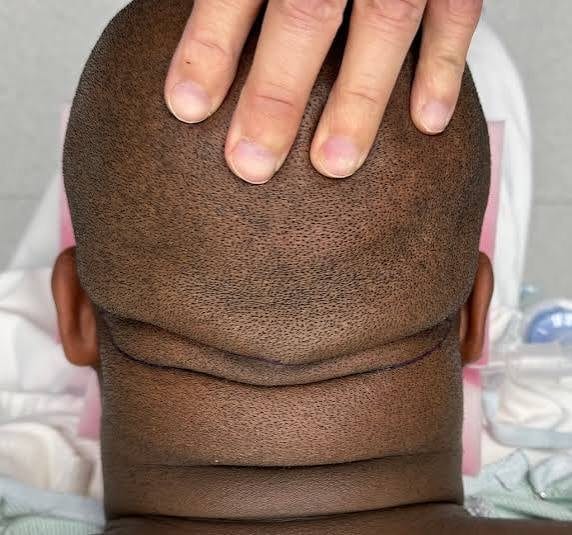
The surgeon places a hand on the back of the head and pushes the skin up, down and to the sides to feel how much it gives, sometimes with a formal scale, mostly from experience. Every previous strip makes the scalp tighter, so the next strip is narrower.
The assessment is done by hand during the consultation. The surgeon places a palm on the donor area and pushes the skin in every direction to feel how far it moves. Some use a fixed scale. Most rely on what their hands have learned from many patients.
Previous procedures change the picture. Every strip that is cut out and stitched takes up some of the slack. That is why the second and third strips get ever narrower, and why there is a ceiling on how many strip operations one scalp can take.
Some surgeons recommend exercises that stretch the scalp in the weeks before the procedure. Whether this makes a noticeable difference is poorly documented. Talk to your surgeon before starting anything like that, rather than following tips from online forums.
Why doesn't scalp laxity set the same limits for FUE?
With FUE nothing is stitched together. Each small punch hole heals on its own without tension, so scalp laxity doesn't limit the yield, and it is density and how much the back of the head can give that set the limit.
FUE leaves no long wound edge that has to be closed. Each punch hole closes on its own, and no skin is under strain. Scalp laxity therefore puts no real limit on how many grafts you can get.
That is a genuine advantage of FUE, not a sales pitch. If you have a tight scalp, you avoid a limit that would have cost you grafts with strip surgery.
The ceiling doesn't disappear, though, it moves. With FUE it is density, and how much you can extract before the back of the head looks sparse, that sets the limit. A different ceiling, but still a ceiling.
What else does scalp laxity affect besides strip width?
A tight scalp often means more pain once the strip has been stitched, and the tension can contribute to the usually temporary numbness after FUT. It also affects later procedures, because each strip uses up slack the next procedure would have needed.
- Discomfort after the procedure. People with a tight scalp usually feel more tightness and tenderness at the back of the head once the strip has been stitched.
- Numbness. Reduced sensation in the donor area after FUT is common and usually passes. Wound tension can contribute.
- Future options. If one strip has already tightened the scalp, there is less slack left for another. That has to be part of any plan that runs over several stages.
What should you ask if the clinic suggests FUT?
Ask how elastic your scalp is and how wide a strip that allows, how many grafts that gives with your density, how the wound is closed and what the scars look like after twelve months. Also ask whether there will be room for another strip, and whether you would get more grafts with FUE.
- How elastic is my scalp, and how wide a strip can it take?
- How many grafts does that width give with my density?
- How do you close the wound, and do you have photos showing scars twelve months afterwards?
- Will there be room for another strip later, or do I only get this one chance?
- Would FUE give me more grafts with the scalp I have?
Sources
- Rassman WR, Bernstein RM, McClellan R, Jones R, Worton E, Uyttendaele H. Follicular unit extraction: minimally invasive surgery for hair transplantation. Dermatologic Surgery, 2002;28(8):720-728. pubmed.ncbi.nlm.nih.gov/12174065
- Romera de Blas C, Vega Díez D, Ricart Vayá JM, Gómez Zubiaur A. Complications in follicular unit excision hair transplantation: current evidence and practical approaches. Frontiers in Medicine, 2026;13:1750989. pubmed.ncbi.nlm.nih.gov/41709896
- Jimenez F, Ruifernández JM. Distribution of human hair in follicular units. A mathematical model for estimating the donor size in follicular unit transplantation. Dermatologic Surgery, 1999;25(4):294-298. pubmed.ncbi.nlm.nih.gov/10417585
- Chauhan K, Tandon M, Kumar A, Taneja N, Hamid SAT. A comprehensive review of evolution of advanced follicular unit excision systems. Journal of Cutaneous and Aesthetic Surgery, 2025;18(2):69-77. pubmed.ncbi.nlm.nih.gov/40212421
This article is based on published research and standard clinical practice. It is general information, not medical advice, and it never takes priority over what your own surgical team tells you. If they say something different from what you read here, follow their advice.
Wondering what's possible for your hair?
Send three sharp photos of your hair, from the front, the top and the back. You'll get an honest answer on what can be done, roughly how many grafts it would take and what it costs.
- Free and with no obligation
- Photos are assessed by the clinic's medical team
- Replies usually within an hour in the daytime


A study tells you something about groups. Only a doctor who has seen your photos can say what applies to your hair. The medical team at the clinic at the top of our ranking offers a free assessment.
Goes to the clinic at the top of our ranking.