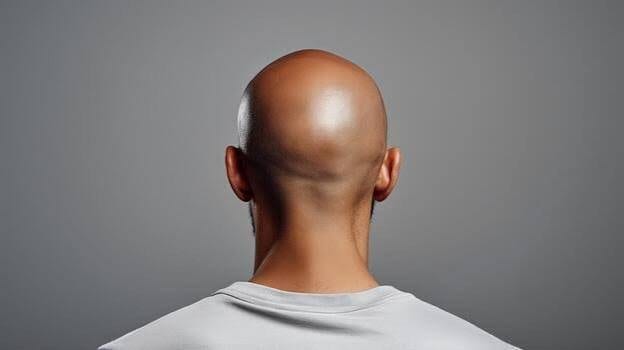
Visible donor scar: SMP, grafts into the scar or scar revision
A scar from extraction can be made less visible. It never disappears completely.
A scar in the donor area can be toned down but never removed. Scalp micropigmentation is the option that most often gives a good result. Grafts placed into a strip scar only help some people, and a surgical revision replaces the old scar with a new one that will hopefully be narrower.
What can be fixed when a donor scar shows?
A stretched strip scar, an FUE area that has been thinned too heavily and thickened scars can all be made less visible. They can't be undone, because follicles that have been removed are gone for good. There's no treatment that rebuilds a depleted donor area, but good camouflage can still decide whether you can wear your hair short or have to keep it long.
Can micropigmentation hide a donor scar?
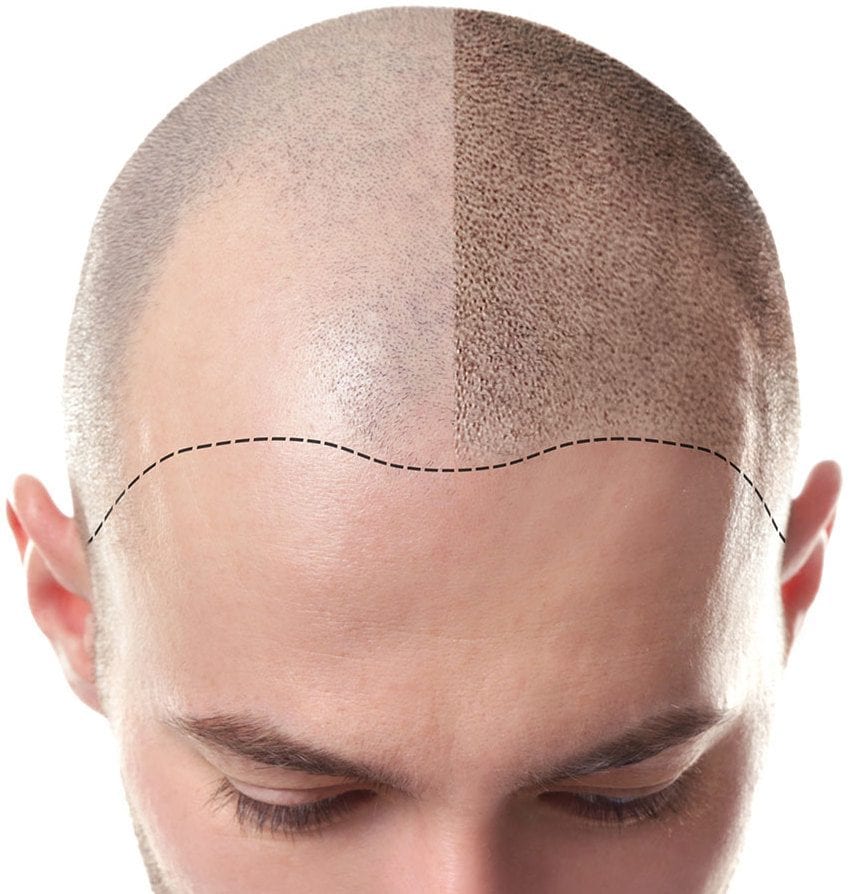
Yes, and for most people it's the place to start. SMP, scalp micropigmentation, places tiny dots of pigment that make the pale scar tissue blend in better with the surrounding skin. It works on strip scars and FUE dots, uses no donor hair and does its job when hair is short. The downside is that it's a tattoo that fades and needs topping up, and the result depends heavily on who does it.
The principle is simple. The pigment mimics hair stubble, so the eye no longer sees a bare line or a pattern of pale dots. For scars in the donor area, this is the option that suits the most people and disappoints the fewest.
- Both scar types. A long line from strip surgery is broken up, and a field of thousands of small FUE scars becomes less noticeable.
- Costs zero grafts. This is the big advantage. You take nothing from a reserve that's often already used up.
- Best where the problem is biggest, that is, when hair is cut short and the scar would otherwise be visible.
- The pigment doesn't last forever. It fades over a few years and needs refreshing, and the colour has to be adjusted as your hair goes grey.
- Quality varies enormously. The field lacks shared standards, and badly done SMP makes things worse. Look at photos of the practitioner's own scar cases before you decide.
If you have a donor problem that shows, SMP is the first option you should have assessed.
Can follicles be implanted into a strip scar?
Yes. The surgeon can place follicular units along a strip scar so the line is less pronounced. Scar tissue has a poor blood supply, though, so fewer grafts survive than in normal scalp. The procedure draws on a reserve that's already limited, it works best in narrow scars that haven't stretched, and the result is often better when combined with SMP.
The idea is to give the scar hair that grows through it. For some patients it works well. For others the yield is so low that the effort barely shows.
- Weaker circulation in scar tissue. The grafts get less blood than in healthy skin, and the proportion that grows is usually lower. Expect a reduced yield.
- The grafts have to come from somewhere. Every hair you move to the scar is one hair fewer for the recipient area at the front. For a patient with little left, that's a real cost.
- The type of scar matters. A narrow scar that hasn't stretched takes grafts better than a wide, thin or thickened scar.
- Together with SMP, the result is often better than with either method on its own.
The same principle can be used in an FUE area that has been thinned too heavily. There, grafts are sometimes taken from the beard or body, precisely because the reserve on the head is used up.
Can a donor scar be revised to make it narrower?
It can, but the result isn't guaranteed. The surgeon cuts out the stretched strip scar and stitches it again, which in experienced hands can give a thinner line. You get a new scar in place of the old one, and if a tight scalp made the first one stretch, the same can happen again. With a trichophytic closure, hairs can grow up through the new line.
A new closure can give a neater line in the right patient. Nobody can promise more than that. One scar is swapped for another, and the conditions that made the first one widen are often still there.
- How elastic your scalp is matters most. Tight skin is the usual reason a strip scar stretches. If the surgeon closes again under the same tension, the problem repeats.
- Trichophytic closure means the edge is cut so hair can grow up through the scar line, and the technique is used to make the result less visible.
- You get another operation, with new healing and a new chance that the outcome is worse than before.
Revision makes sense when the scar is genuinely wide, the scalp is elastic and the surgeon is experienced. For a narrow scar that only shows when the head is shaved, it rarely makes sense.
Which repair suits my scar?
It depends on the scar. After FUE with scattered thinning and visible dots, and for narrow strip scars, SMP is the first choice. If the strip scar is wide and the scalp elastic, revision is considered first and SMP afterwards. With a tight scalp, SMP alone is safer. Thickened scars should be examined by a dermatologist before anything cosmetic is done, and either way you should get an assessment from someone other than the clinic that made the scar.
- After FUE, with scattered thinning and visible dots: SMP. Beard grafts can add extra fullness if the reserve allows it.
- Narrow strip scar that only shows with very short hair: SMP.
- Wide, stretched strip scar in an elastic scalp: have revision assessed first. SMP or grafts can be added to the new scar later.
- Wide, stretched scar in a tight scalp: SMP, ideally combined with grafts.
- Thickened scars: this is first a medical question for a dermatologist, and the cosmetic side comes afterwards.
Whichever category you fall into, let someone other than the clinic that created the problem assess it.
You'll find how to go about correcting an earlier procedure more generally under repair and correction.
Sources
- Romera de Blas C, Vega Díez D, Ricart Vayá JM, Gómez Zubiaur A. Complications in follicular unit excision hair transplantation: current evidence and practical approaches. Frontiers in Medicine, 2026;13:1750989. pubmed.ncbi.nlm.nih.gov/41709896
- Umar S, Khanna R, Maldonado JC, Chouhan K, Gonzales A. Beard and Body Hair Transplantation by Follicular Unit Excision Using a Skin-Responsive Device: A Multicenter Study. Dermatologic Surgery, 2024;50(3):306-308. pubmed.ncbi.nlm.nih.gov/38127669
- Rassman WR, Bernstein RM, McClellan R, Jones R, Worton E, Uyttendaele H. Follicular unit extraction: minimally invasive surgery for hair transplantation. Dermatologic Surgery, 2002;28(8):720-728. pubmed.ncbi.nlm.nih.gov/12174065
- Jimenez F, Ruifernández JM. Distribution of human hair in follicular units. A mathematical model for estimating the donor size in follicular unit transplantation. Dermatologic Surgery, 1999;25(4):294-298. pubmed.ncbi.nlm.nih.gov/10417585
- Zhu DC, He Y, Fan ZX, Wang J, Qu Q, Hu ZQ, Miao Y. Large-Scale Beard Extraction Enhances the Cosmetic Results of Scalp Hair Restoration in Advanced Androgenetic Alopecia in East Asian Men: A Retrospective Study. Dermatology and Therapy, 2020;10(1):151-161. pubmed.ncbi.nlm.nih.gov/31784942
This article is based on published studies and on how specialists usually work. It is meant as general information, not as medical advice for you, and it never takes precedence over what your surgical team has asked you to do. If they say something different from what is written here, their advice is the one to follow.
Wondering what's possible for your hair?
Send three sharp photos of your hair, from the front, the top and the back. You'll get an honest answer on what can be done, roughly how many grafts it would take and what it costs.
- Free and with no obligation
- Photos are assessed by the clinic's medical team
- Replies usually within an hour in the daytime


A study tells you something about groups. Only a doctor who has seen your photos can say what applies to your hair. The medical team at the clinic at the top of our ranking offers a free assessment.
Goes to the clinic at the top of our ranking.