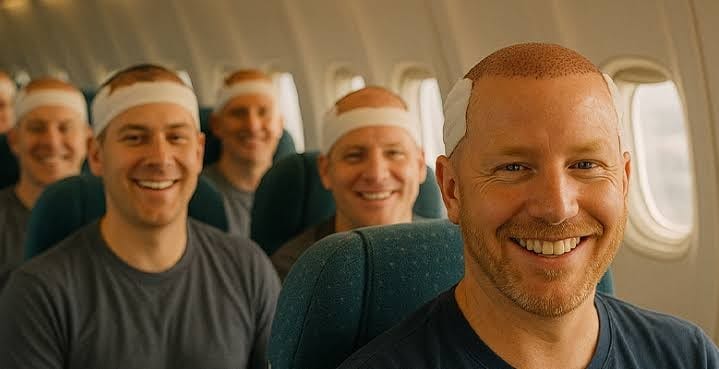
Flying after a hair transplant: what is the real risk?
Your grafts can handle the flight home. Even so, the clinic will usually want you to stay until you've had your first check-up and first hair wash.
Your grafts can handle the flight home. Even so, the clinic will usually want you to stay until you've had your first check-up and first hair wash. What can actually go wrong happens at the airport and in the cabin: crowds, suitcases, overhead lockers, dry air and your head sinking back against the headrest when you fall asleep.
Can cabin pressure damage the grafts?
No. The cabin of a commercial aircraft is pressurised, and the small pressure difference does nothing to grafts that have been placed. It's a common worry, but what matters for your head is everything that happens around the journey.
What can actually harm your head when you fly?
Overhead lockers, the classic way to bump a newly transplanted head. Queues at security and boarding. Shoulder straps and heavy suitcases. Headrests that press against the back of your head when you fall asleep. The dry cabin air, which makes scabs hard. And tight caps or hoods that have to be pulled on and off.
- Overhead lockers, the classic place to bump a freshly transplanted head
- Queues and crowds at security and boarding
- Luggage, from shoulder straps to heavy suitcases you have to lift
- The headrest, which presses against the back of your head when you fall asleep
- Bone-dry cabin air, which makes scabs hard
- Tight hats and caps that have to come on and off
How soon can you fly home?
Normally you stay until the first check-up and hair wash, most often a couple of days after the operation. That follow-up matters more than the flight itself. So it's wise to avoid package trips that put you on a plane only a few hours after the operation.
The bigger planning is covered in the guide to travelling abroad for a hair transplant.
How can you make the flight easiest on your scalp?
Bring a neck pillow so the back of your head stays off the seatback. Spray saline on the skin throughout the journey. Book an aisle seat so you can get out without squeezing past your neighbours. Check in your suitcase instead of lifting it into the locker. Choose a loose hoodie over a cap, and drink water, not alcohol.
- A neck pillow, so the back of your head stays off the seatback
- Saline spray in an approved bottle, used throughout the journey
- An aisle seat, so you can get out without squeezing past
- A checked suitcase, not cabin luggage that has to go up in the locker
- A loose hood rather than a cap
- Water, not alcohol, which increases swelling
Sources
- Muhm JM, Rock PB, McMullin DL, Jones SP, Lu IL, Eilers KD, Space DR, McMullen A. Effect of aircraft-cabin altitude on passenger discomfort. The New England Journal of Medicine, 2007;357(1):18-27. pubmed.ncbi.nlm.nih.gov/17611205
- Bernstein RM, Rassman WR. Graft Anchoring in Hair Transplantation. Dermatologic Surgery, 2006;32(2):198-204. pubmed.ncbi.nlm.nih.gov/16442039
This article summarises published studies and common clinical practice. It is general information, not medical advice. The instructions from your own surgical team always come first, including where they differ from what you read here.
Wondering what's possible for your hair?
Send three sharp photos of your hair, from the front, the top and the back. You'll get an honest answer on what can be done, roughly how many grafts it would take and what it costs.
- Free and with no obligation
- Photos are assessed by the clinic's medical team
- Replies usually within an hour in the daytime


A study tells you something about groups. Only a doctor who has seen your photos can say what applies to your hair. The medical team at the clinic at the top of our ranking offers a free assessment.
Goes to the clinic at the top of our ranking.